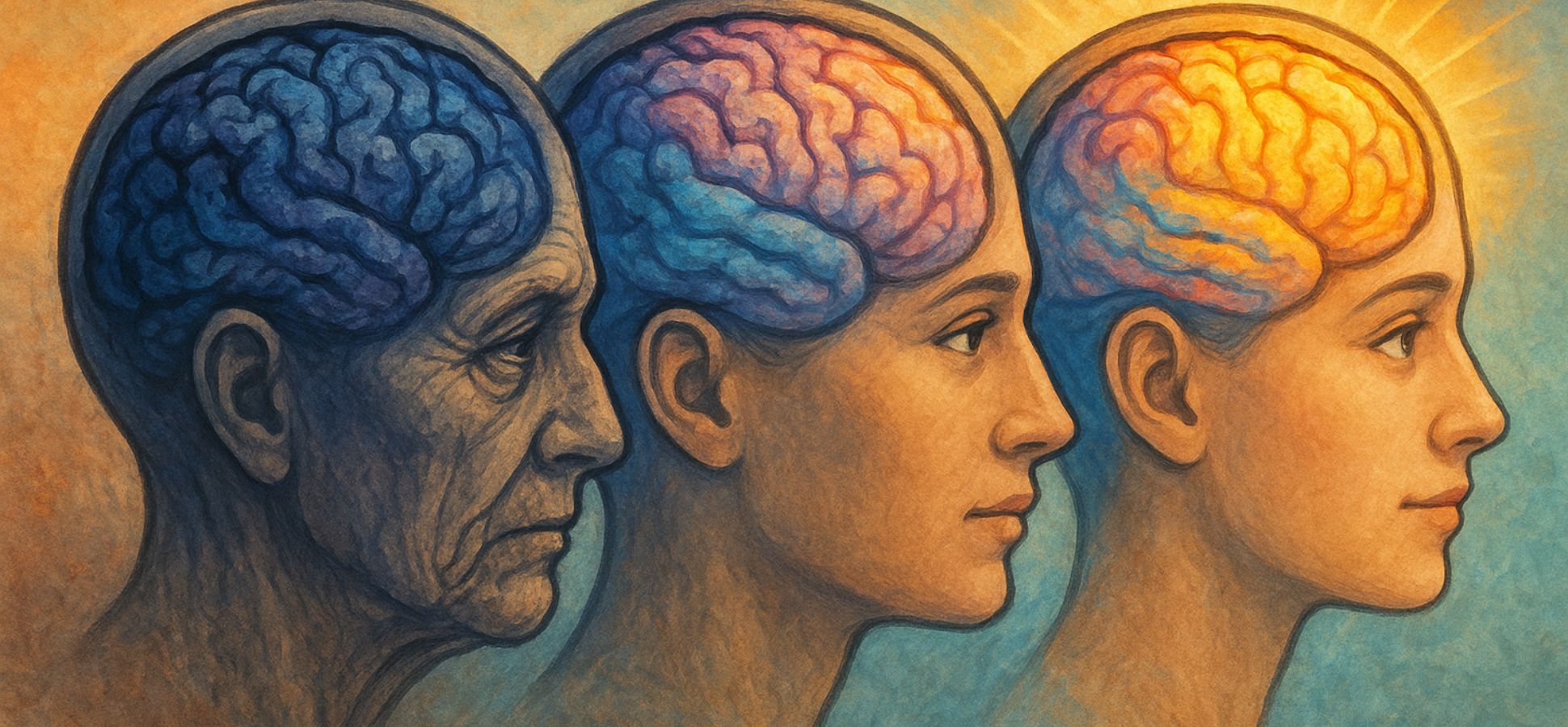
Last month, I found myself standing in my kitchen, staring at the fridge, completely blank on why I had opened it in the first place. I had a feeling it was something important — eggs? almond milk? — but the thought slipped away before I could catch it.
Sound familiar?
We laugh it off as “getting older,” but those small moments — forgetting names, misplacing keys, losing your train of thought mid-sentence — are often the quiet signs of how our brains slowly change over time. For years, we’ve been told that’s just how it goes. The brain gets older, slower, and foggier, and there’s nothing we can do about it.
But what if that wasn’t true?
Recent research suggests something that sounds almost too good to be real: we might actually be able to reverse brain aging — not just delay it, but roll it back.
Turning Back Time — Literally

A team of scientists at the University of California, San Francisco (UCSF) recently discovered a protein in the brain called FTL1 that seems to act like a dimmer switch for aging. When they reduced this protein in older mice, something incredible happened — the mice started to show signs of younger brain activity. Their memory improved. Their neurons looked healthier. They behaved, quite literally, like younger versions of themselves.
Dr. Saul Villeda, who led the research, described it best:
“This isn’t just preventing decline — it’s reversing impairments. We’re seeing the brain regain youthfulness.”
That statement hit me. Imagine if we could do the same for humans. What if your brain at 60 could think, remember, and create like it did at 30? What if burnout, mental fatigue, and brain fog weren’t permanent symptoms of modern life, but fixable ones?
Memory Loss, Meet Modern Science

Of course, we’re not injecting anyone with miracle serums yet — the research is still in early stages. But it’s part of a larger wave of studies challenging what we thought was inevitable.
At Harvard Medical School, researchers are studying how small doses of lithium — yes, the same mineral often used in mood stabilizers — might help rejuvenate aging brain cells and slow Alzheimer’s progression. Meanwhile, at Cedars-Sinai, scientists have used young immune cells to repair aging brain tissue in animal models.
In other words, the scientific community is whispering what might soon become a roar: aging isn’t just a one-way street.
And if the brain — our most complex organ — can age in reverse, that changes everything.
Why This Matters for Everyday Entrepreneurs
As someone who lives in the entrepreneurial world, I see brain fatigue every day.
Founders who work 14-hour days, juggling ideas, strategy, and survival. Creators who burn out chasing the next big launch. Executives who stare at spreadsheets at midnight, knowing they’ll wake up and do it all again.
We’ve built a culture that demands constant mental performance but rarely pauses to ask — what are we doing to protect that performance?
If brain aging truly can be slowed or reversed, this isn’t just medical news — it’s entrepreneurial news. It’s a chance to think about longevity differently.
Imagine a future where:
- You can retain creativity and focus deep into your 60s.
- “Founder burnout” isn’t the inevitable price of success.
- Your brain ages more slowly than your company grows.
This isn’t science fiction anymore. It’s the frontier of wellness, biotech, and human potential — all areas ripe for innovation.
A Personal Take
I don’t think of this research as a magic pill, but more as a mirror — a reminder that our brains are alive, adaptable, and constantly changing.
When I think about brain aging, I think about my grandmother. She was a schoolteacher who read everything she could get her hands on — philosophy, poetry, even tech blogs in her 70s. She always said, “The brain is like a garden. Stop watering it, and it forgets how to bloom.”
Science is finally catching up to what she already knew — that the brain isn’t meant to simply fade; it’s meant to renew.
So yes, while researchers in lab coats work on reversing molecular aging, the rest of us can take smaller, more human steps to “rewind” our minds:
- Learn something new, even when it’s uncomfortable.
- Sleep — really sleep — like your brain depends on it (because it does).
- Eat foods that fuel you, not drain you.
- Stay curious. Stay connected. Keep creating.
What Comes Next
The UCSF discovery might take years before it translates into human therapies, but the mindset shift starts now. Reversing brain aging isn’t just about neuroscience; it’s about how we live, think, and care for ourselves every day.
If the brain truly has the potential to get younger, the question for all of us — founders, creators, dreamers — is this:
What would you do with a mind that feels brand new again?