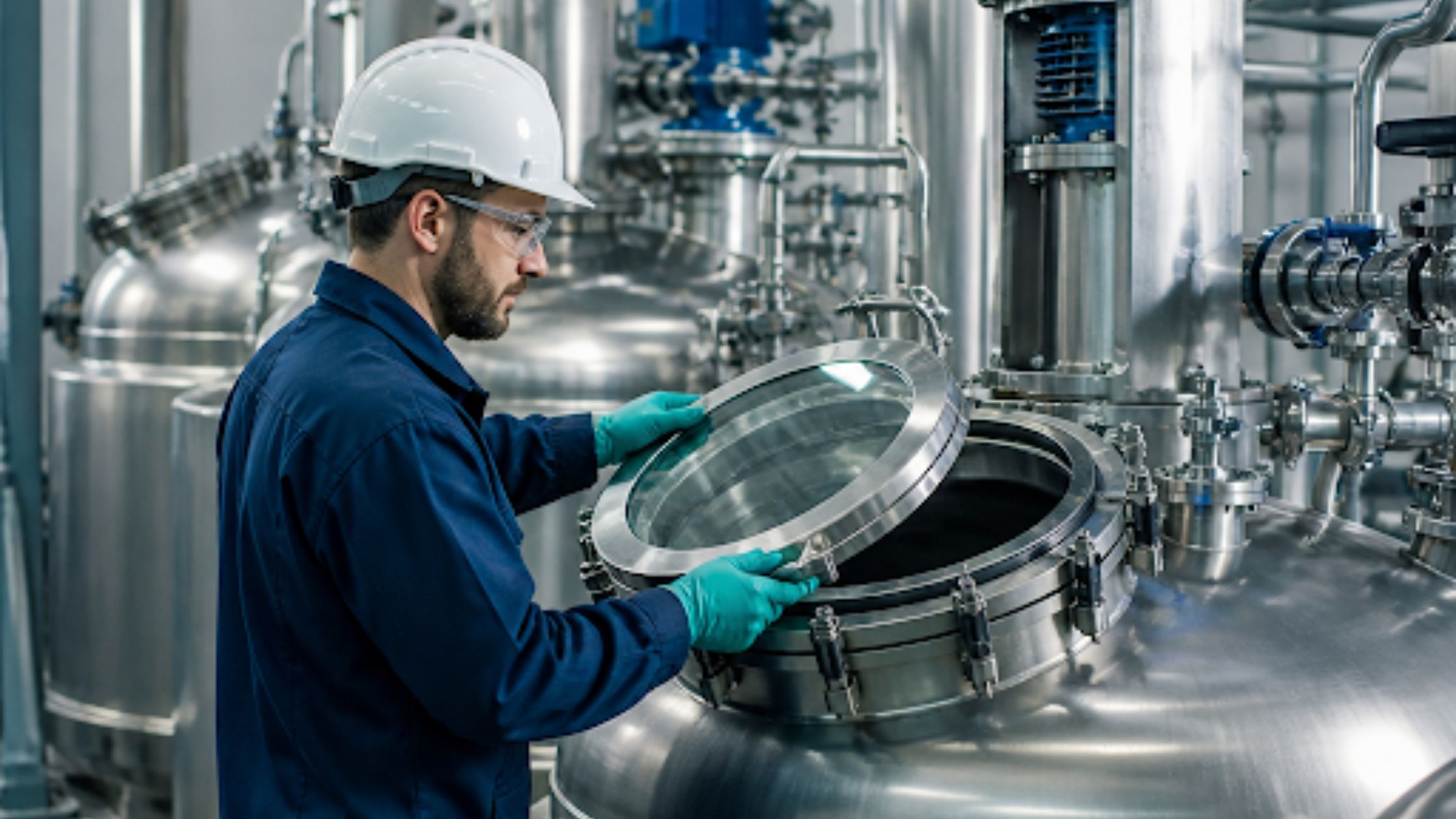
The convergence of enzyme engineering and process equipment technology is creating new opportunities for pharmaceutical and specialty chemical manufacturers. As biocatalytic routes replace traditional synthetic chemistry in more applications, existing reactor infrastructure often requires adaptation rather than wholesale replacement. Understanding how conventional process vessels can support enzymatic transformations allows facilities to expand capabilities while preserving capital investment.
Equipment Characteristics That Matter for Enzyme-Based Processes
Biocatalytic reactions impose different demands on process equipment than thermal or pressure-driven chemistry. Temperature control becomes more critical because most enzymes denature above 60°C, and many show peak activity within narrow ranges of 25 to 45°C. Jacketed vessels with reliable cooling circuits and temperature monitoring at multiple points deliver the precision needed. Agitation requirements shift as well: gentle mixing preserves enzyme structure while maintaining substrate-enzyme contact, making variable-speed drives and customizable impeller configurations valuable.
Material compatibility takes on new dimensions. Enzymes are sensitive to metal ion contamination, so stainless steel grades 316L and higher remain standard, while glass-lined vessels offer particular advantages for reactions where trace metal leaching could inhibit catalytic activity. Surface finish matters more than in many chemical processes, as rough interiors create dead zones where enzymes can aggregate or denature. Electropolished interiors with Ra values below 0.8 micrometres help maintain consistent suspension and prevent protein fouling.
Reactor Design Elements That Support Catalyst Stability
pH control infrastructure becomes essential when working with biological catalysts. Most enzymes operate within pH windows spanning one to two units, and some are sensitive to fluctuations as small as 0.2 units. Reactors equipped with automated pH monitoring and reagent addition ports allow precise buffering throughout reaction cycles. The capacity to add base or acid in controlled increments, coupled with efficient mixing, prevents localized pH spikes that would inactivate enzymes.
Oxygen transfer capacity determines throughput for oxidase and peroxidase reactions, while strict anaerobic conditions matter for certain reductase applications. Vessels with sparger systems designed for fine bubble dispersion maximise gas-liquid interfacial area without subjecting enzymes to destructive shear forces. Headspace pressurisation capability extends operational flexibility, allowing manipulation of dissolved gas concentrations without changing agitation parameters that might stress the biocatalyst.
Transitioning Existing Assets to Biocatalytic Service
Many pharmaceutical and fine chemical facilities maintain reactor fleets purchased for traditional synthetic chemistry that can be adapted for enzyme-catalysed production. A reactor originally specified for Grignard reactions or hydrogenations under pressure may serve biocatalytic processes after modification. The core vessel often requires minimal change if construction materials and temperature control infrastructure meet biological requirements.
When manufacturers evaluate their options for expanding into biocatalytic production, sourcing a used reactor with appropriate specifications can provide substantial lead time and cost advantages over new fabrication. Stainless steel and glass-lined vessels from facilities that have upgraded or changed production focus frequently meet the material compatibility and thermal control requirements for enzymatic chemistry. The availability of reactors in the 100 to 2,000 litre range particularly suits pilot and small-scale commercial biocatalytic processes, where rapid implementation matters more than custom optimisation.
Retrofitting focuses on control systems and ancillary equipment rather than pressure vessel modification. Modern distributed control systems integrate with older reactors through new instrumentation packages, bringing the precision temperature and pH management that enzymes require. Addition of in-line spectroscopy ports for real-time reaction monitoring supports adaptive process control, while upgraded CIP systems ensure the sanitary conditions biological catalysts demand between batches.
Enzyme Immobilisation and Reactor Configuration
Fixed-bed reactor configurations gain prominence when enzymes are immobilised on solid supports. This approach offers catalyst recovery and reuse advantages that change process economics substantially. A packed column reactor where substrate solution flows through an enzyme-loaded resin bed can operate continuously for weeks or months, provided the support matrix resists compression and maintains flow distribution. Temperature control through jacketed columns or recirculation through external heat exchangers maintains the narrow thermal windows biological catalysts require.
The emergence of nanozyme catalysts as enzyme mimetics with enhanced stability is influencing how process engineers specify reactor systems for catalytic applications. These synthetic alternatives tolerate broader temperature and pH ranges than natural enzymes while retaining substrate specificity, potentially allowing use of higher-temperature glass-lined or Hastelloy vessels that would denature protein-based catalysts. The technology remains in transition from laboratory to production scale, but equipment selection increasingly accounts for hybrid scenarios where conventional enzymes and synthetic mimetics may both find application within the same facility.
Structural and Safety Considerations
Biocatalytic processes typically operate at atmospheric or modest positive pressure, reducing mechanical stress compared to high-pressure hydrogenations or polymerisations. This characteristic expands the range of used equipment suitable for enzyme-based production, as vessels no longer certified for their original design pressure may still meet requirements for biological transformations. Proper engineering assessment remains mandatory, and guidance from resources such as structural analysis standards for process equipment ensures that any reactor, regardless of service history, meets current safety expectations.
Thermal expansion calculations simplify when operating envelopes narrow. Enzymes rarely require heating beyond 50°C, and exothermic reactions typically release less energy than traditional organic syntheses. Jacket design pressure and heat transfer coefficients calculated for 150°C service provide substantial margin at biological temperatures, but control valve sizing and cooling water capacity still require verification to ensure adequate heat removal rates during scale-up.
Economic and Operational Realities
Capital efficiency drives adoption of reconditioned process equipment in segments where innovation happens faster than depreciation schedules allow. A pharmaceutical company developing a novel enzymatic route to an active ingredient may complete clinical trials and reach commercial launch before a newly fabricated reactor fleet arrives. Used vessels that meet material and control requirements compress project timelines, allowing manufacturing readiness to track product development rather than lag it by eighteen months or more.
Operating cost structures shift when biocatalysis replaces conventional chemistry. Lower reaction temperatures reduce energy consumption by 40 to 70 percent compared to thermal processes, while ambient pressure operation eliminates inert gas blanketing and high-pressure safety systems. Solvent volumes often decrease because enzymes function in aqueous media, reducing both raw material expense and waste treatment burden. These changes make smaller, well-instrumented reactors economically competitive with larger vessels that rely on economies of scale to offset energy and material intensity.
Future-Proofing Biocatalytic Infrastructure
Flexibility matters more than optimisation when process technology evolves rapidly. Reactor systems that accommodate both traditional and enzymatic chemistry give manufacturers options as synthetic routes change. Modular skid-mounted designs with standardised utility connections allow reconfiguration as product portfolios shift, while multi-purpose vessels with comprehensive instrumentation support process development and small-scale commercial production simultaneously.
The trajectory of industrial biotechnology points toward increasing integration of biological and chemical catalysis within single facilities. Equipment procurement strategies that balance immediate needs with adaptability position manufacturers to adopt new enzyme technologies as they emerge from research laboratories. Whether through thoughtful specification of new vessels or strategic acquisition of well-maintained used equipment, building a reactor fleet capable of supporting both conventional and biocatalytic processes delivers competitive advantage in markets where speed and versatility determine success.