

The holodeck was one of the most fascinating story elements of Star Trek: The Next Generation. Viewers loved watching Captain Jean-Luc Picard and his crew enter immersive 3D simulations to explore virtual replicas of actual places, discover imaginary worlds, and interact with hyperrealistic AI-generated characters. Fast forward to 2021, and the holodeck’s real-world equivalent—the metaverse—seemed poised to become a reality. Brands in various industries – from fashion to finance – eagerly sought partnerships with metaverse trailblazers, hoping to tap into this new digital frontier for innovation and commerce.
What is the Metaverse?
The metaverse is a concept in development. This hypothetical digital universe would be a virtual, interactive, and immersive place where people socialize, work, learn, shop, exercise, play, create—and much more. The hope is that different digital worlds and economies will seamlessly integrate and extended reality (XR) will be adopted into our daily routines. While current hardware is far from delivering Star Trek’s holodeck experience, companies like Meta, Apple, and Sony are advancing spatial computing with smart glasses and virtual reality (VR) headsets.
Platforms offering metaverse-like opportunities include social-oriented spaces like Horizon Worlds and Second Life, while others are game-oriented, like Roblox, The Sandbox, Fortnite, and Minecraft. Each platform has marketplaces for users to buy and sell digital content like clothing for avatars or adventure maps. With companies like Minecraft attracting 100 million users and Roblox garnering 79.5 million daily active users, many companies recognize the value of promoting their brands in these spaces and the opportunity to shape the virtual world through immersive experiences.
“Phygital” branding and corporate social responsibility
Users need an avatar—a digital representation of themselves—to live and interact in the digital world. To blur the line between the physical and digital worlds, brands create ” phygital ” customer experiences. Users can clothe their avatars in brand-specific digital clothing and accessories while dressing in the physical equivalent in the real world. For example, Burberry and Minecraft teamed up to create the Burberry x Minecraft capsule collection, fusing “in-game motifs with unmistakable Burberry icons”. By visiting the Minecraft Marketplace, players can access “15 downloadable skins based on fashion, fantasy and adventure”. Burberry sells comparable Minecraft-branded clothing online and in brick-and-mortar stores.

On the surface, this may seem like an odd pairing – Minecraft’s primary audience is school-aged children, not luxury goods consumers. However, both brands appreciate “the wonder of nature,” and each committed to donate “$100,000 to Conservation International’s forest protection and restoration programs” for the “adventurers of tomorrow”. The Burberry x Minecraft collaboration provides customers with a phygital immersive experience while still demonstrating corporate social responsibility to promote conservation and sustainability of the tangible planet.
Galaxy teamLab collab: a branded experience to delight and build community
AR experiences can attract and delight potential customers and keep current customers enthusiastic members of the brand community. For example, in 2022, Samsung’s Galaxy Harajuku store collaborated with teamLab to create the AR experience, “Catching and Collecting in the Dinosaur Forest.” teamLab is a Japanese digital art collective famous for creating immersive, interactive art experiences that blend technology, art, and nature. In the dinosaur-themed AR adventure, users scanned art projections with the provided smartphone in search of dinosaurs and reptiles hidden in the projection. Once the phone recognizes an animal, a digital bow with an arrow or a net appears on the screen, allowing the user to catch and study the reptile. Players could work with others in the shared physical space to capture dinosaurs, add them to their collection books, and then release captured animals into the virtual wild.
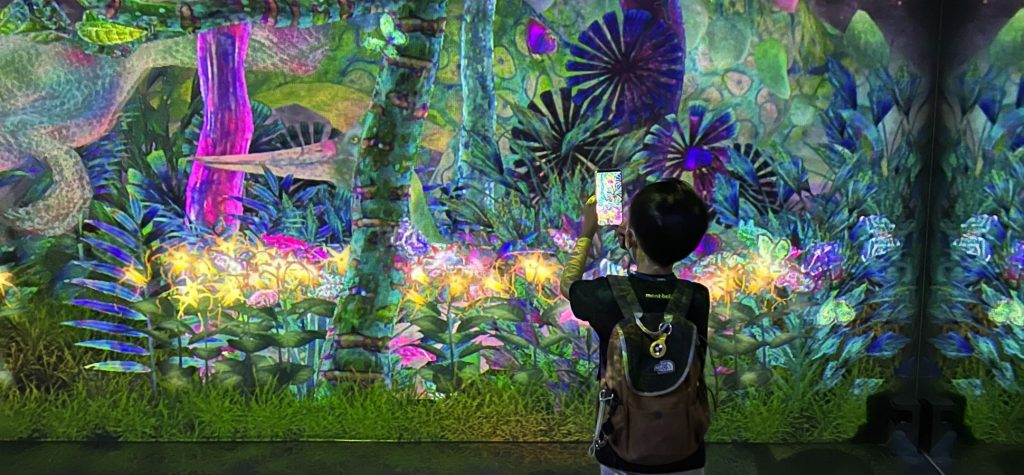
This joint venture aligned with several of Samsung’s core values—prioritizing people, staying connected to the evolving cultural landscape, and embracing playfulness—while highlighting teamLab’s growing cultural impact. This free immersive experience encouraged visitors to enter the physical Galaxy store, try their product, and have “transformative and unparalleled experiences that offer an insight into the future.”
What’s next?
Some companies still seem eager to incorporate digital experience into their brand. The luxury brand, Balenciaga, provides customers an immersive digital experience of the Spring/Summer 2025 collections via the Apple Vision Pro. This digital event aims to make users “feel as though they’re seated at a Balenciaga show. Captured with specialized cameras and advanced post-processing, the footage provides a truly immersive viewing experience.”
Likewise, Meta announced a new partnership with Lightstorm Vision, filmmaker James Cameron’s venture. Their goal is to create “world-class 3D entertainment experiences spanning live sports and concerts, feature films, and TV series featuring big-name IP on Meta Quest—which will be Lightstorm Vision’s exclusive MR hardware platform.”
Other brands are losing interest in the long-term investment in the metaverse. Nike is one example. In December 2021, Nike acquired RTFKT, a digital wearables company that worked with “game engines to craft NFTs and AR experiences that transcended the physical borders of fashion”. Nike hoped RTFKT would expand its cultural influence and profitability in the metaverse as customers purchased virtual products for their avatars and other digital collectibles. But just three years later, in December 2024, Nike announced on X that it was shutting RTFKT down by the end of January 2025. The decision seems to come due to declining interest in digital assets and the decrease in Nike’s market share.
With 2025 just beginning, there will be more changes and innovations on the digital horizon. What is certain is that the line between the physical and virtual worlds is increasingly blurred. This transformation provides unique opportunities for companies to create meaningful brand experiences for their customers, establish their digital identity, and influence the growth of the emerging metaverse.


