Every November, the largest Christmas tree farms in America bring in helicopters. At Holiday Tree Farms in Oregon, crews cut more than a million trees in under 30 days while seven helicopters work the slopes, each lifting roughly a thousand trees an hour out to the loading yards, where the trees get baled and stacked onto trucks bound for Home Depot lots on the West Coast. The trees arrive three to four days later. The Hustle documented the operation in 2024, and the detail that sticks isn’t the helicopters. It’s the calendar. A tree that gets flown off that hillside in November was planted sometime around 2017.
That gap is the whole business, and it’s the part the internet keeps leaving out. Search for what a Christmas tree farm earns and you’ll get a dozen pages quoting tidy per-acre figures, some as high as $50,000 an acre a year, almost none of them sourced. A Christmas tree farm is a plantation that grows conifers on a staggered seven-to-ten-year rotation, selling them wholesale to retail lots or directly to customers who cut their own. The rotation is why most of those numbers are wrong. They describe one harvested acre in one good year, then quietly present it as what a farm makes annually.
Federal data tells a plainer story. Divide the money by the trees and the average American Christmas tree left its grower for about $38.
Last updated: November 2026
Quick answers
How much do Christmas tree farms make? US growers sold $553 million in cut Christmas trees in 2022 on more than 14.5 million trees, according to the USDA’s 2022 Census of Agriculture. That averages about $38 per tree at the farm gate. A wholesale grower keeps roughly $8 to $10 of it as profit.
How much does a Christmas tree farm make per acre? A harvested acre yields around 720 sellable trees from 1,200 planted. At wholesale margins that’s roughly $5,800 to $7,200 in profit, earned once at the end of an eight-to-ten-year rotation rather than every year.
How long before a Christmas tree farm makes money? A seedling needs eight to ten years to reach six feet. Expect no tree revenue at all for the first five years minimum, while paying for mowing, shearing, fertilizer and pest control every one of those seasons.
How much do Christmas tree farms make per tree?
About $38 per tree in gross sales, and roughly $8 to $10 in actual profit for a wholesale grower. Those are two different numbers and conflating them is the first mistake most would-be growers make.
The gross figure comes straight from federal data. The USDA’s Economic Research Service, summarizing the 2022 Census of Agriculture in December 2024, reported that growers sold $553 million in cut Christmas trees from more than 14.5 million trees, raised on roughly 16,000 farms across all 50 states. Divide one by the other. The average tree in America sold for a little under $38, and that’s before a single cost comes out.
The profit figure comes from the trade. The Hustle surveyed eight wholesale Christmas tree farms in 2024 and found an average six-to-seven-foot tree wholesaling for about $35, cut, baled and loaded onto the truck. Growers described margins of roughly 25% to 30%, which lands at $8 to $10 a tree.
Now put that next to what the customer pays. The American Christmas Tree Association pegs the average six-foot fresh tree at around $80, with the full range running from $25 to $2,500. The retailer, not the grower, captures most of the gap. The Hustle found retailers typically marking wholesale trees up 100% or more.
So the $80 price tag on the lot is doing almost none of the work people think it’s doing. It’s the number that makes tree farming look like a license to print money, and it’s the number a grower almost never sees.
Why profit per acre is the most misleading number in the business
Profit per acre is close to meaningless for a Christmas tree farm, because you cannot harvest your acreage every year. This is the single biggest distortion in the published numbers, and almost nobody states it plainly.
Here’s the mechanic. If a tree takes eight years to reach sellable height and you want trees to sell every December, you have to stagger your plantings. One block goes in each year. Eight years later the first block comes out, and from then on you’re harvesting roughly one-eighth of your ground annually while the other seven-eighths sit there growing and costing you money. An eighty-acre farm in steady state is harvesting about ten acres a season.
Which means a figure like “$50,000 per acre” is describing a harvest-year acre, not the farm. Divide it across the rotation and it’s closer to $6,000 an acre a year in gross, before costs, assuming the acre performs. Several of the pages ranking for this question make exactly that error, presenting a once-a-decade payout as annual income.
Then there’s attrition, and it compounds. The Hustle reports most growers target around 1,200 trees per acre. University of Tennessee Extension puts typical plantation density at 900 to 1,200. But planted is not sellable. In both of the case studies in UT Extension’s financial analysis of the crop, 20% of seedlings died in the first year, and the growers ultimately marketed 75% of what remained. Run 1,200 through that and you get about 720 sellable trees per acre planted. You lose two trees in five before anyone pays you for one.
Stack the two corrections together and the arithmetic gets honest. Roughly 720 sellable trees at $8 to $10 of wholesale profit is about $5,800 to $7,200 per acre, earned once, at the end of a decade of spending. Call it $600 to $900 per acre per year. That’s the real shape of it.
How much does it cost to start a Christmas tree farm?
Startup costs run modest on a per-acre basis and the land dominates everything else. Seedlings, site prep and planting are cheap. Waiting is what’s expensive.
The Hustle puts seedlings at $0.50 to $1 each, typically bought from a timber supplier such as Weyerhaeuser. At 1,200 trees that’s $600 to $1,200 an acre in stock. UT Extension’s budget, which was last revised in 2002 and so understates current dollars, lists site preparation at $50 to $200 per acre, total planting costs at $200 to $300 per acre, and replanting after mortality at $40 to $60.
The recurring costs are what people forget, and they start immediately and never stop. UT Extension’s line items include mowing at $25 to $35 per acre per pass, herbicide at $40 to $60, fertilizer at $40 to $60 per application, insecticide anywhere from $50 to $250, and deer fencing at around $300 per acre. Shearing, the annual hand labor that gives a tree its cone shape, starts near $50 per acre on young stock and climbs as trees get bigger. In the Virginia case study, cash expenses averaged about $600 per acre every year.
Adjust those 2002 figures for two decades of inflation and input costs and the picture is a few thousand dollars an acre to establish, then low four figures per acre annually, for eight to ten years, before the first dollar of tree revenue arrives. Compared with other ventures we’ve run the numbers on, that’s an unusual cost curve. A Christmas light installation business starts for about $2,400 and can bill inside a month. A HYROX-style gym opens for $1,500 in the leanest version. Tree farming inverts that: cheap per acre, brutal on time.
The real capital question is the land, and it’s the one the calculator sites skip entirely. You either own suitable acreage already or you’re buying it, and at that point you’re running a land investment with a crop attached rather than a business with a real estate expense. That distinction changes the whole analysis.
How long before a Christmas tree farm makes money?
Eight to ten years for a six-foot tree, and five years at the absolute fastest with a quick-growing species on a good site. Plan on a decade before the operation turns cash positive.
The Hustle puts the standard timeline at eight to ten years to reach six feet. UT Extension is more optimistic in places, noting growers can see “a profit in as little as five to seven years,” and one of its case studies did get Virginia pine to market in five years in central Louisiana. Species and climate move the number more than management does.
UT Extension’s two worked examples are the most useful public illustration of how the money actually behaves over that span, with the caveat that the dollar figures are from 2002:
A Virginia grower running white pine on 20 acres in the southwest of the state spent $80 an acre on site prep and $220 an acre planting roughly 1,000 trees. She lost 20% in year one, replanted for $55 an acre, sold 75% of her trees at an average wholesale price of $12, and ended with a present net worth of $1,755 per acre at a 10% discount rate. Her internal rate of return came to 35%.
A Louisiana grower doing Virginia pine planted 1,000 trees an acre for about $136, also lost 20% in the first year, marketed 75% at $10.50 a tree, and harvested some in year four and the rest in year five. His present net worth was $1,296 an acre at the same discount rate, with an internal rate of return of 50%.
Those IRRs look terrific, and they are, on the acres that work. But notice what they encode: a 35% or 50% annualized return on a small amount of capital tied up for years, not a large annual income. The report itself warns that the two cases are not directly comparable, since the species, geography, costs and rotation lengths all differ.
It’s worth sitting with the fact that this 2002 document is still the most rigorous cost-and-returns budget available to the public for the crop. Nearly every per-acre figure circulating online traces back to it, to a competitor’s guess, or to nothing at all.
Is a Christmas tree farm profitable?
Yes, on a discounted-return basis, and no, as a source of annual income at small scale. Which of those matters depends entirely on your sales channel and your acreage.
The channel choice does more to determine a grower’s income than the growing does. There are three ways trees reach a buyer, and the economics differ sharply.
| Channel | Price per tree | Who cuts and hauls | Gross per harvested acre | Best for |
|---|---|---|---|---|
| Wholesale | ~$35 (6-7 ft, per The Hustle’s 2024 survey) | The farm cuts, bales and loads | ~$25,200 on 720 trees; $8-$10/tree net | Larger acreage with harvest equipment and crews |
| Choose-and-cut | ~$80 average retail for a six-footer (ACTA) | The customer cuts; no hauling | Up to ~$57,600 on 720 trees, capped by foot traffic | Farms within driving distance of a metro area |
| Own retail lot | Full retail, with a 100%+ markup captured | The farm does everything, plus transport | Highest per tree, minus lot rent and seasonal staff | Growers with a nearby urban market and cash for staffing |
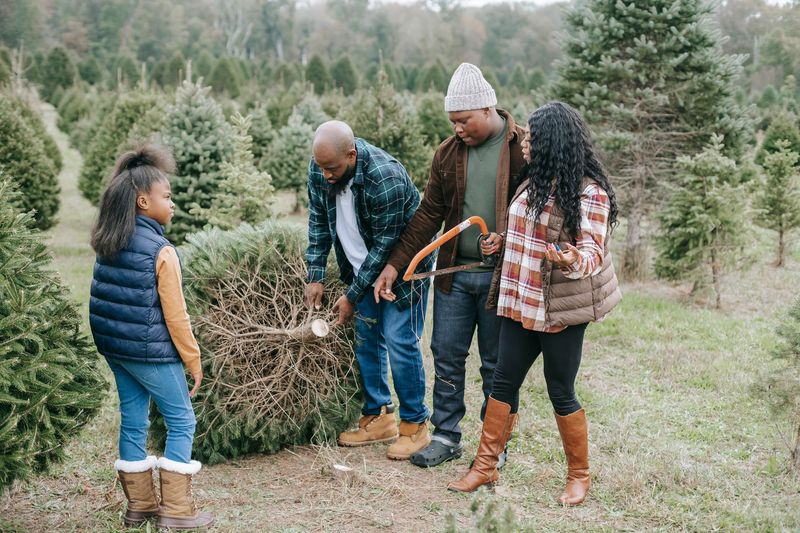
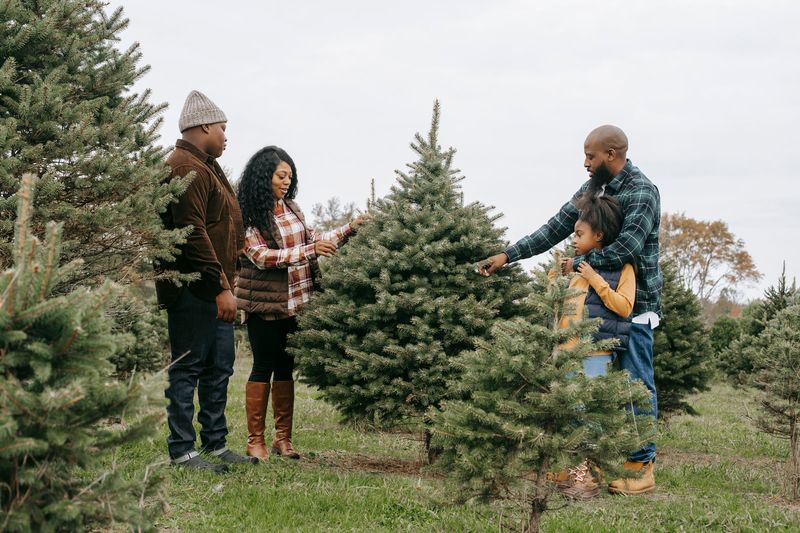
Those per-acre gross figures assume 720 sellable trees and no cost deductions, so treat them as ceilings rather than forecasts. The choose-and-cut column is the one worth staring at. Selling the same tree yourself roughly doubles the revenue per tree against wholesale, and it’s why roughly a third of Christmas tree sales now move through U-cut, according to The Hustle. The catch is that choose-and-cut isn’t really a farming business. It’s a seasonal retail and agritourism business that happens to own its inventory, with parking, liability insurance, seasonal staff, restrooms, marketing and weekend crowds. Growers who succeed at it tend to be running something closer to a holiday pop-up operation than a commodity crop.
Scale is the other hard constraint, and the industry is far more concentrated than it looks. The Hustle found that the 434 largest farms control about 75% of total US supply, with around 350 million trees in the ground nationally at any given time. Oregon and North Carolina alone account for more than half the trees cut, per the USDA. If you’re planting ten acres, you are not competing with those operations on price, and you shouldn’t try.
What the 2026 season looks like for growers
Supply is the story, and it has been since the last drought cycle. The USDA recorded about 550,000 fewer trees cut in 2022 than in 2017, and attributed the decline to prolonged drought. Because a replacement tree takes most of a decade, a bad planting year shows up on the lot eight years later and there’s no way to accelerate the fix.
That lag explains the pattern in the federal numbers. Sales climbed from $377 million in 2017 to $553 million in 2022, up about 47%, while the trees cut fell roughly 3.7%. Average revenue per tree went from near $25 to near $38 across those five years. Growers didn’t sell more. They sold fewer trees for considerably more money, and imports filled part of the gap, with more than three million trees coming in during 2022.
For anyone evaluating this as a business, that reframes the opportunity. The pitch you’ll hear is rising demand. The data says tightening supply. Those have different implications: a supply-driven price run rewards growers who already have mature inventory, and it does nothing for someone planting seedlings this spring, who will meet whatever market exists in the mid-2030s.
On near-term pricing, grower intentions have cooled. The most recent grower survey reported by the American Christmas Tree Association found 25% of growers planning wholesale increases of 5% to 15%, down sharply from 71% the prior year, with 48% planning increases of 5% or less and more than a quarter holding prices flat. Read that as the price spike maturing rather than accelerating.
Who should actually do this
Christmas tree farming works as a yield play on land you already own and can’t otherwise monetize. It works badly as a career change or a cash-flow business.
The honest test has three parts. Do you already control suitable acreage, so the land isn’t a cash outlay? Can you absorb eight to ten years of costs with no crop revenue, from other income? And are you within reasonable driving distance of enough population to run choose-and-cut, which roughly doubles your revenue per tree? Two yeses out of three and the numbers can work. One or fewer and you’re buying yourself a decade of mowing.
The framing from David Mercker, the University of Tennessee extension forester behind that budget, is the useful one, and it’s right there in the title: this is a crop for marginal farmland. Ground that won’t support row crops, that’s sloped or rocky or awkward to work, can carry conifers and throw off a 35% internal rate of return on a modest capital base. That’s a genuinely good outcome for otherwise idle land. It is not a salary.
Geography decides more than ambition does. Oregon and North Carolina dominate production because their climates grow saleable conifers faster and more reliably than most of the country, and the USDA’s drought finding is a reminder that a single bad stretch of weather removes trees you won’t be able to replace for another decade.
If what you actually want is seasonal income this year, the same holiday demand is reachable with a far shorter payback. We’ve looked at the economics of haunted houses, which turn over in a single October, and at low-cost franchises and padel court builds for people weighing capital against time to revenue. Even indie software, with its own brutal distribution of outcomes, pays or fails inside a year rather than a decade.
The trees will still be there. That’s rather the point of them: a Christmas tree farm is one of the few businesses where the correct planning horizon is measured in presidential administrations, and the growers doing well in 2026 are collecting on decisions made around 2017. If you plant this spring, you’re not betting on this year’s $80 price tag. You’re betting on 2035.