

The speed at which AI is advancing surpasses that of virtually all other recent innovations. By 2025, artificial intelligence would have already altered how individuals work, how they learn, and how they earn—and it’s still in the early phases. With automation gaining pace, there is an abundance of opportunities available to those entrepreneurs willing to act now, long before the market becomes saturated.
You don’t need to be a seasoned coder or have a big pile of venture capital to start an AI-based business. Home-based AI product development and monetization are now accessible to all, requiring only the most basic of investments, thanks to no-code platforms, APIs, and other open-source resources.
This guide outlines five profitable AI businesses you should start before 2026. Each idea includes a description of how it works, the minimal resources you need, and a few straightforward steps to create your first MVP. These AI opportunities allow you to earn a smart income, whether you are working on a side hustle or a full-fledged startup.
Key Takeaways Before You Dive In
1. AI accessibility is at its peak.
You can now create powerful AI-driven products using low-cost tools and no-code platforms—no programming background required.
2. Early adoption means long-term gains.
Starting before 2026 lets you capture market share, build user trust, and grow before competitors flood the space.
3. Focus on solving real problems.
The best AI businesses thrive when they make life simpler—think automation tools, smart assistants, and data-driven solutions.
4. Start lean and scale smart.
Most of these ventures need less than $100 to begin and can scale naturally with reinvested profits.
5. Stay sustainable, not trendy.
Avoid chasing hype. Build tools or services that add consistent value, even as AI trends evolve.
How to Evaluate AI Business Ideas
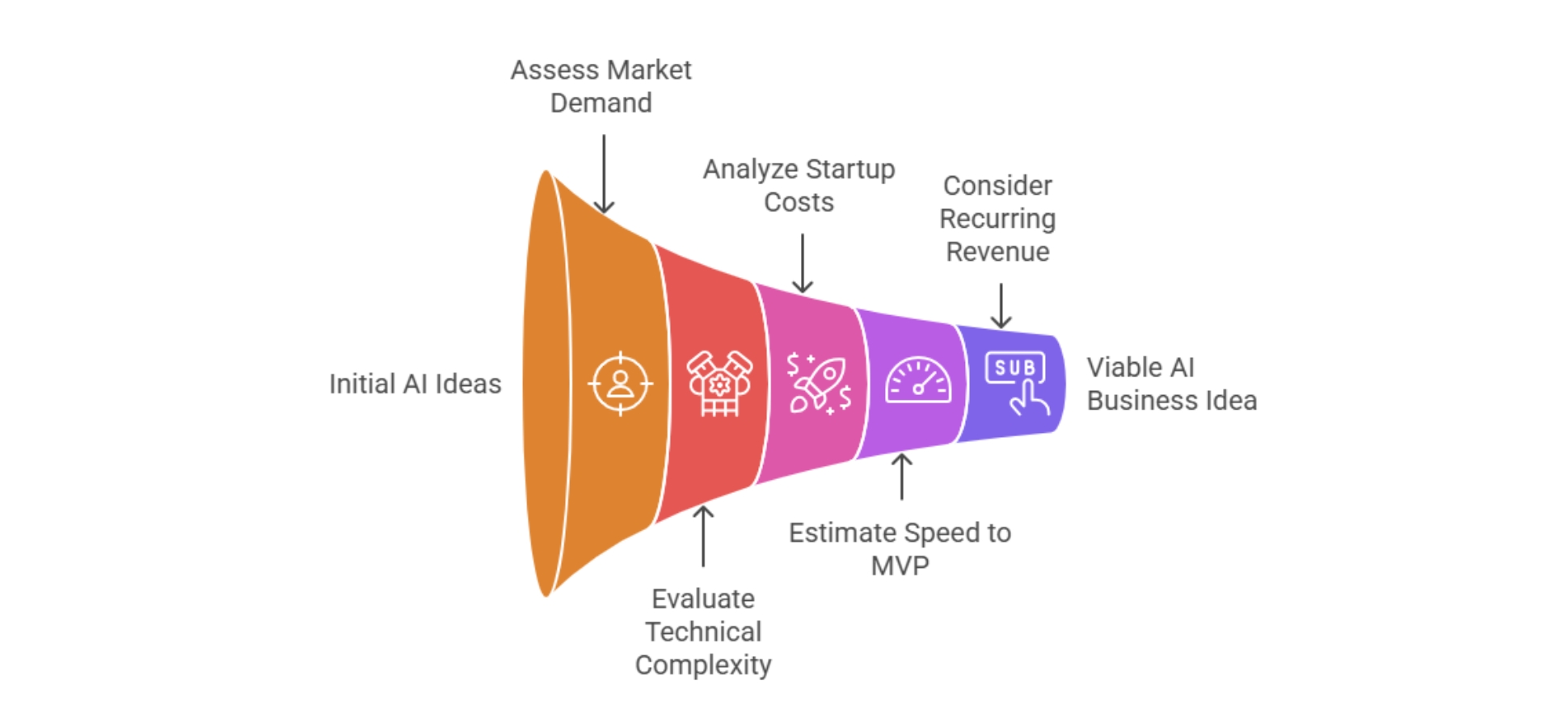
Before evaluating AI ideas, it’s important to analyze why specific ideas are better than others. All profitable AI businesses possess particular characteristics—and recognizing them will help you pick the most appropriate company for your time, skills, and money.
Market Demand
Choose problems that impact a large number of people or businesses. AI tools that save time and reduce costs or automate repetitive tasks are in high demand.
Technical Complexity
As a beginner, prioritize projects that you can accomplish with low-code tools and pre-trained models. In the beginning, stay away from extensive bespoke model training.
Startup Costs
Seek business models that can be initiated with free tiers like OpenAI’s pay-as-you-go API, Zapier’s starter tools, or Bubble’s free prototype plan.
Speed to MVP
The sooner you can validate your concept with target users, the sooner you can determine whether it’s worth your time.
Recurring Revenue
Subscription or SaaS business models scale up seamlessly. Monthly users generate passive income, unlike one-off transactions.
Understanding the most essential elements—demand, simplicity, and recurring value—lets you rapidly sort through poor ideas and concentrate on AI projects that are worthwhile.
AI Business Idea 1 – GPT Wrappers and Niche Chat Apps

The simplest way to dip your toes into AI startups is to build GPT wrappers—customized AI chat tools for targeted industries or particular problems. You won’t make your own model; instead, you ‘wrap’ an existing mill, like GPT-4 or Claude, with a tailored experience.
What It Is
A GPT wrapper combines prompt engineering, domain-specific data, and user-friendly design to containerize AI for a particular audience. Think of tools like:
- A description generator for real-estate agents
- A document summarization tool for law students
- A customer support assistant for Shopify sellers
These tools are exact. Each solves a specific, frequent problem. This precision is what makes them profitable.
How to Build It
To build systems like this, identify a niche with a repetitive, language-centric task. Outline the parameters for the user input (questions, data) and define the expected output (answers, reports, summaries).
You can use OpenAI API, Cohere, or Anthropic for text generation, and Bubble, Softr, or Glide for simple front-ends—no code is required.
Then you can integrate the API, the prompt testing system, and end with a user-friendly beta.
Monetization
Charge a monthly fee for premium access or a pay-per-use model via Stripe. You can also embed your tool in communities (Reddit, Discord) where users already face the problem you solve.
Why It Works
Businesses are overwhelmed with manual content tasks and want plug-and-play AI tools. GPT wrappers meet this need fast, without you building complex infrastructure. With minimal setup, you can create a recurring revenue stream for under $50 in startup costs.
AI Business Idea 2 – AI-Powered Marketing Tools for SMBs
When it comes to marketing, small-to-medium businesses (SMBs) always need some sort of assistance—be it with social media, advertisements, emails, or SEO content writing. Most SMBs cannot afford to pay for marketing agencies. Automated marketing solutions, on the other hand, are in much demand. This is where AI comes in to help with marketing automation.
What It Is
The AI marketing automation tools will use natural language processing and images to generate various forms of marketing collateral on the fly. Encapsulated automation tools like AI caption generators, product-photo makers, or ad copy assistants are some examples of what can be developed.
How to Build It
Determine one marketing problem. Consider small Shopify sellers who need help writing Instagram captions for their products every day. You could create an AI app for captioning photos where users input a product photo and get a caption and hashtags in return.
You can build the automation with Make (Integromat) or Zapier to connect inputs and outputs, and then host the app on Notion, Carrd, or use a WordPress plugin.
Monetization
You can adopt a freemium model where a user can generate a set number of captions and then start paying a monthly subscription of $10–$20 or unlimited caption generation. Agencies could be offered a white-label option to help them resell the automation tool to their users.
Why It Works
One of the most significant sectors in the B2B software industry remains marketing automation. You can target a small subset of a marketing automation tool, like real estate advertising, to gain a loyal customer base. Most small businesses will convert easily to paying customers with the value of a software tool that will save them time.
AI Business Idea 3 – Voice AI and Branded Voice Services
As the adoption of smart speakers and voice-activated applications proliferates, the potential offered by Voice AI technology increases rapidly. Voice technology is not only a valuable marketing tool; it is also a critical customer support service. Potential customers need to be spoken to, and voice technology can help facilitate and streamline interactions.
What it is
Voice AI encompasses the technologies of speech recognition and text-to-speech conversion to create tools that interact and communicate with users conversationally. Companies are now using voice technology to create unique customer interactions, akin to custom-branded versions of Siri and Alexa.
Consider the following:
- AI voiceovers used by content creators on YouTube and TikTok
- Custom voicebots used in customer service applications
- Marketing campaign narrated podcasts that use a voice bot
How to build it
Use tools such as ElevenLabs, Play.ht, or OpenAI’s TTS models to generate lifelike speech. Combine these with Zapier or Make for automation and Descript or Audacity for editing.
For beginners, start by offering AI voiceover services on Fiverr or Upwork. You can use client scripts and deliver ready-to-publish voiceovers in multiple tones and accents once you’ve built a few templates, scale by offering voice-as-a-service subscriptions to businesses needing regular content.
Monetization
You can charge per minute of audio or offer monthly packages for recurring clients. Another option is to license custom voices to brands wanting consistency across ads, explainer videos, or e-learning content.
Why It Works
With content creators and small brands producing endless video and audio content, the demand for quick, professional-sounding voice production is exploding. Voice AI provides a low-cost, high-demand service that anyone can start with a computer and an internet connection.
AI Business Idea 4 – AI Health and Wellness Assistants

AI isn’t only for enhancing business operations; it has begun to help with one’s personal health and wellness, too. From therapy chatbots to meal planners, consumers expect personalized and intelligent wellness and health support and systems.
What It Is
AI health and wellness assistants help guide and track users’ physical and even mental well-being. They augment personal improvement habits and help users, for example, eat healthier, sleep more, and manage stress with daily interactions. However, it is important to note that these AI systems do NOT replace a professional’s services.
Examples include:
- AI fitness coaches that create and adapt workout plans in real time
- Meditation bots that provide personalized affirmations
- Meal prep assistants that adapt to users’ dietary preferences
How to Build It
For building these systems, start with existing AI tools like OpenAI for conversation, CalorieNinjas for nutrition data, and the Fitbit API for activity tracking. Use no-code app development tools like Glide or Adalo to create a mobile interface.
For user safety and to be compliant, clinicians must include a disclaimer that the AI will provide only informational support, no medical guidance. This will help you provide value to users while minimizing risk.
Monetization
Use a freemium model, free basic access with paid upgrades for advanced tracking, analytics, or coaching insights. Alternatively, collaborate with fitness coaches or nutritionists and license your app as a branded solution.
Why It Works
The global wellness economy is expected to exceed $8 trillion by 2026. People want AI that helps them stay consistent with health goals. If your assistant genuinely improves routines, word-of-mouth marketing alone can fuel steady growth.
AI Business Idea 5 – AI Automation Services for Local Businesses

Even the smallest local businesses – including coffee shops and real estate offices – have begun using AI for basic marketing, scheduling, and data entry. This trend creates opportunities for freelancers and small business owners to provide AI automation services.
What It Is
You could become a local AI consultant. You would provide systems that automate processes that are simple yet time-consuming. You won’t have to create new software; just consider integrating software and automation tools that small business owners use and are familiar with, but don’t have the time to figure out completely.
Examples are:
- Automating appointment scheduling systems for salons,
- AI chatbots that respond to customer inquiries on websites,
- Auto-generating responses to Google reviews and emails.
How to Build It
Start by learning basic workflow automation tools such as Zapier, Chatbase, or Make. Pair them with GPT or Claude for natural-language tasks. Offer small packages like:
- “AI customer support setup” for $200
“Automated social posting system” for $150
You can deliver real value within days — and as clients grow, you can transition them to monthly retainers for maintenance.
Monetization
Charge per project or offer subscription-based automation management (e.g., $99/month for ongoing AI workflow upkeep). You can even expand into training local business staff to use AI tools efficiently.
Why It Works
Local businesses urgently need affordable automation to stay competitive, yet they lack time or expertise. Position yourself as their go-to AI partner, and you can build steady recurring revenue while helping your community thrive.
How to Start an AI Business Step by Step
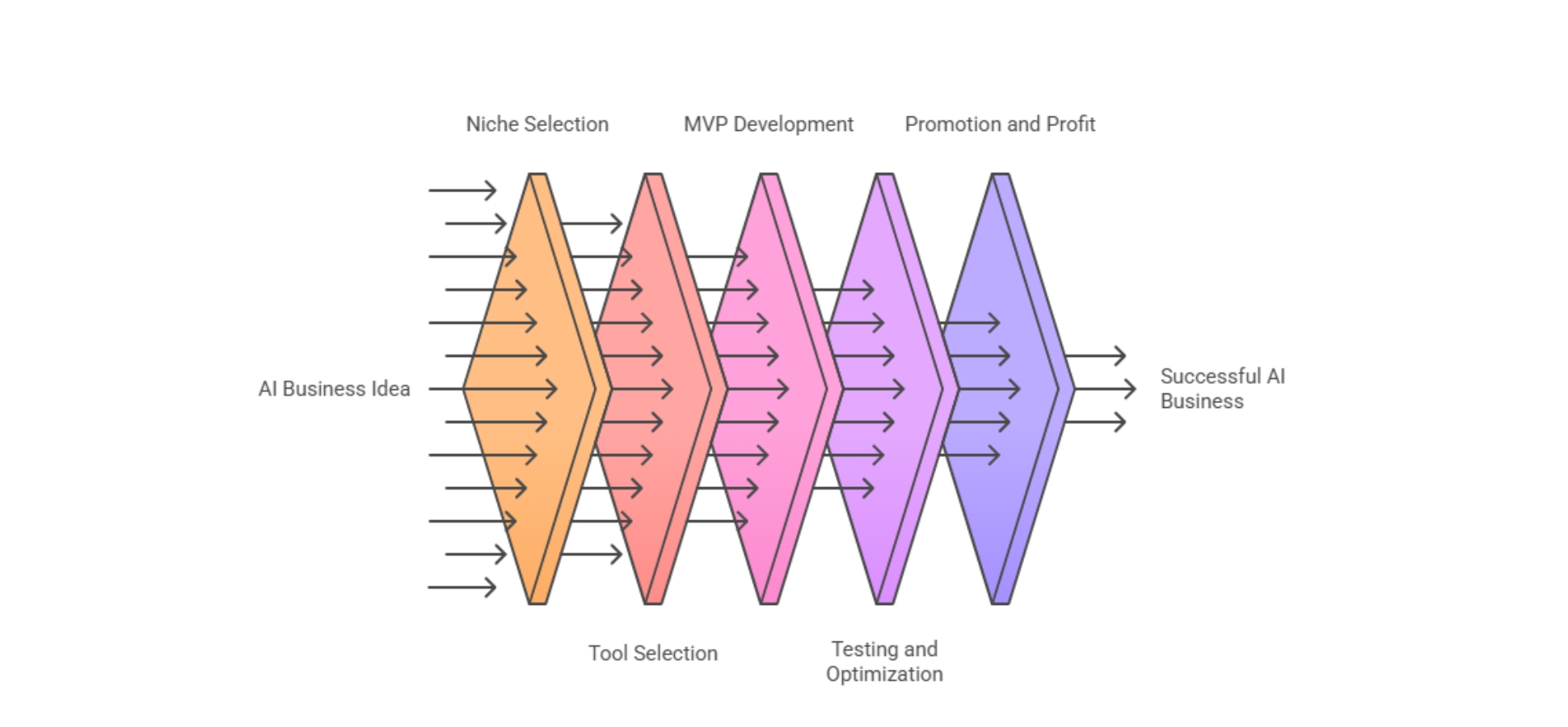
Now that you’ve seen the most profitable AI business ideas, let’s walk through how to turn any of them into a real, income-generating venture. These steps apply no matter which niche or model you choose.
Step 1 – Pick Your Niche and Define the Problem
Start with a singular, clear pain point. The more narrowly defined your audience is, the simpler marketing your item becomes.
For instance, instead of just creating an AI copywriter, make one for eCommerce store owners who require daily ad copy written. The real profits are made by solving targeted problems instead of general ones.
Step 2 – Choose Your Tools
There is no need to develop everything from the ground up. Use tools such as:
- OpenAI / Anthropic for text and chat models
- Hugging Face / Replicate for deploying an AI workflow
- Bubble, Glide, or Webflow for front-end development
- Stripe for payment processing
Sometimes, small is better; your primary version needs only to be functional.
Step 3 – Build a Minimum Viable Product (MVP)
Construct a basic template exhibiting the primary function of your AI; an application that converts paragraphs into captions, or a chatbot that replies to a company’s frequently asked questions, for instance. Also, be sure to capture feedback from users as soon as you can. This is crucial for your improvement.
Step 4 – Test and Optimize
Release the most miniature version of your product to a limited audience; consider niche Reddit, Discord, or Twitter communities. Analyze what performs well, what doesn’t, and what people are willing to pay. Iterate as quickly as possible; the AI market changes every month, not every year.
Step 5 – Promote and Profit
When your product provides substantial value, implement a freemium model to acquire users. Create a value gap to give testimonials and share results to build social proof. Focus on content marketing and make videos or tutorials to show how your AI product provides value.
Capture emails and automate your nurture sequence. Engagement provides customers, but only over time.
The Roadmap to Success
Creating a winning business model with AI before 2026 is not just feasible but a significant opportunity for success in the current digital marketplace.
You are now aware of the five AI business ideas that are low-cost yet high-opportunity.
- GPT Wrapper and Chat Apps
- AI Marketing Tools
- Voice AI and Branding Services
- AI Health and Wellness Assistants
- AI Automation for Local Businesses
Whether you are looking to bring in some passive income or to lay the foundations of a business in the AI sector, the approaches are the same: Spot a gap in the market, utilize available AI technology, and serve the needs of the clients.
Keep in mind that, in the long run, improvement from the basics will beat complications; Consistency, creativity, and a willingness to learn.
It is advisable to start with achievable goals. There is a real chance that you will have a profitable AI predominated business by 2026.


