Jennifer Garner’s co-founder John Foraker spent part of a November 2 analyst call explaining why a product responsible for 18% of Once Upon a Farm’s sales this year was coming off shelves in 45 states.
Three days earlier the company had recalled every lot of its Tractor Wheels Organic Toddler Soft-Baked Bars over a choking hazard. The stock closed at $15.91 on October 30. By November 2 it was $9.45, and every page answering the Jennifer Garner net worth question for 2026 went stale overnight.
The FDA advisory described the hazard plainly: when chewed, the bar “forms a dry, sticky mass that standard choking interventions, including back blows and the Heimlich maneuver, may fail to dislodge.” The agency said it had received several reports of toddlers aged roughly 18 months to two and a half years losing their airway completely.
Garner co-founded the company, sits on its board, and holds 3,057,280 shares and exercisable options, or 7.1% of the class. On the day Once Upon a Farm listed in February, that position was reported at roughly $64 million. Nine months and one recall later, the same holding is worth closer to $28 million on paper. Almost every page still quotes February.
Jennifer Garner’s net worth is built on two engines that behave nothing alike: a roughly three-decade acting career, and a 7.1% beneficial stake in Once Upon a Farm, the organic baby-food company she joined as a co-founder in 2017 and helped take public in February 2026. One of those engines pays a fixed amount. The other reprices every ninety seconds the market is open.
Last updated: November 2026
Quick answers
How much is Jennifer Garner worth in 2026?
The only part of Garner’s wealth with a public, verifiable number is her Once Upon a Farm position: 3,057,280 shares and exercisable options, worth roughly $28 million gross at the November 5 share price of about $9.20, down from about $64 million at the February IPO. Her acting income is not disclosed anywhere, so every published total is an estimate.
Is Jennifer Garner’s $64 million stake figure still accurate?
No. The $64 million figure reflects the share price just after the February 6, 2026 IPO. At roughly $9.20 per share on November 5, the same 3,057,280 units carry a gross paper value near $28 million. The gross figure also overstates what she could realize, because about 1.12 million of those units are options with an exercise cost attached.
Why did Once Upon a Farm stock fall in November 2026?
The company recalled every lot of its Tractor Wheels Organic Toddler Soft-Baked Bars on October 30 over a choking hazard, and the FDA advised consumers not to buy or serve them. Chief executive John Foraker told analysts the product represented about 18% of year-to-date net sales. Shares fell from $15.91 on October 30 to roughly $9.20 by November 5.
How much is Jennifer Garner worth in 2026?
The honest answer is that one half of the number is public to the share and the other half is guesswork. Garner’s Once Upon a Farm holding is filed with the SEC and repriced daily by the New York Stock Exchange. Her acting earnings are not disclosed by anyone, and the figures circulating on celebrity-finance sites, which run from roughly $80 million to $135 million, are reverse-engineered from box office and reported salaries.
Forbes put her career acting earnings at at least $125 million in its coverage of the listing. Treat that as a floor estimate from a publication that does this work seriously, not as a disclosed figure.
What makes the 2026 version of this question different is that for the first time, a meaningful slice of Garner’s wealth has a ticker. Before February 6, her stake in a private baby-food company was a number that moved once every funding round. A 2022 round led by CAVU Consumer Partners valued the business at $371 million. Then it sat there. Now it moves every trading day, and in the week of October 30 it moved a long way down.
This is the part that gets flattened in most coverage of founder net worth. A private stake and a public stake are not the same asset wearing different clothes. One is marked once a year by a negotiation. The other is marked continuously by strangers.
How much does Jennifer Garner own of Once Upon a Farm?
Garner beneficially owns 3,057,280 shares of Once Upon a Farm common stock, equal to 7.1% of the class, as of March 31, 2026. That comes from her Schedule 13G, filed with the SEC on May 15, 2026, which reports sole voting and sole dispositive power over all of it.
The filing breaks the position into three pieces:
- 1,788,861 shares held directly by Garner
- 146,683 shares held by the Jennifer Garner Trust
- 1,121,736 shares underlying options that are fully exercisable
That last line matters more than it looks. Roughly 37% of her reported position is options, not stock. Options carry a strike price, and the filing does not disclose it in the ownership section, so the gross paper value you get by multiplying 3,057,280 by the share price overstates what she could actually realize. Every headline figure, including the $64 million one, has this same flaw baked in. Nobody mentions it.
The percentage also moved. Before the offering, the prospectus showed Garner holding 2,702,671 shares, about 9% of the company. She sold into the IPO as a selling stockholder, which is why the post-offering figure is lower. Co-founder John Foraker held a similar pre-offering position of about 8.9%. The institutional investors, CAVU, S2G Ventures, and Cambridge, together held roughly 70%.
Worth saying plainly: 7.1% of a company is not control. Garner is a board member and the public face of the brand, and her shares will be outvoted by the funds on anything that matters.
What the recall did to the number in four trading days
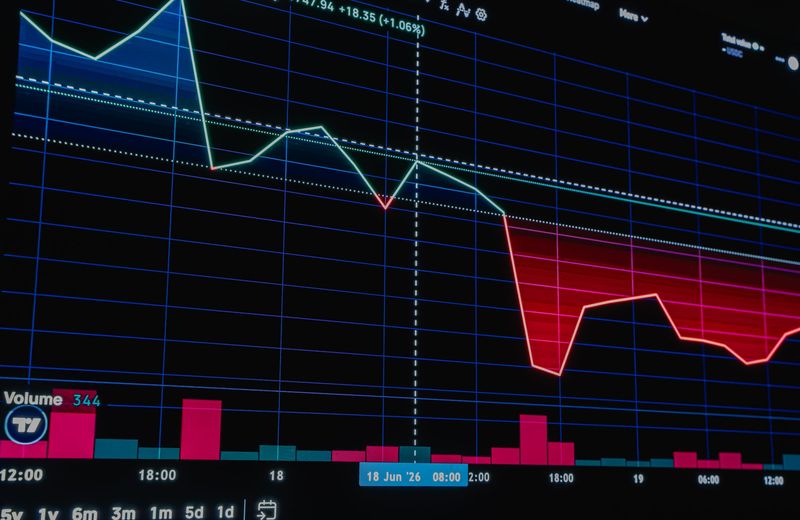
Between October 30 and November 5, Once Upon a Farm shares fell from $15.91 to roughly $9.20, taking about $20 million off the gross paper value of Garner’s position in four trading days. Measured from the IPO, the stock sits roughly 49% below its $18 offer price.
The sequence, as reported by FoodNavigator, went like this. The company recalled every lot and flavor of Tractor Wheels bars on October 30. The FDA issued its consumer advisory and updated it on November 3. Foraker told analysts on November 2 that the recalled product accounted for about 18% of year-to-date net sales, and that the company was acting “out of an abundance of caution, in the best interest of our customers and our commitment to quality.” He said the company had not yet identified a root cause.
Wall Street moved fast. Bank of America cut the stock from Buy to Underperform and dropped its price target from $21 to $10. TD Cowen kept a Hold and cut its target from $18 to $13. The company’s own statement, quoted by ABC News, was unusually direct for a public company: “We know that parents place their trust in us every time they buy one of our products. We fell short of that, and that is why we are taking these aggressive actions.”
Here is the arithmetic nobody has run. At the October 30 close of $15.91, Garner’s 3,057,280 units carried a gross value near $48.6 million. At roughly $9.20 on November 5, the same units carry roughly $28.1 million. Against the approximately $64 million reported after the IPO, the position is down something like $36 million in nine months.
She did not sell anything. She did not do anything wrong. The number moved because a supplier process somewhere produced a bar that behaved badly in a toddler’s mouth, and 7.1% of that outcome is hers.
Two caveats that honest coverage has to carry. The 13G reports holdings as of March 31, 2026, so her position may have changed since. And roughly 1.12 million of those units are options with an undisclosed strike, so the realizable figure is below the gross one. The company reports third-quarter results on November 12, which is the next real repricing event.
What business does Jennifer Garner own?
Once Upon a Farm is a Delaware public benefit corporation selling cold-pressed organic baby and kids food, best known for refrigerated pouches, and it is a real operating business rather than a branding exercise. Curtis and Raz started it in 2015. Foraker, who ran Annie’s and took it public in 2012, joined in 2017 and brought Garner with him.
The numbers from the company’s S-1/A show the shape of it:
- Net sales of $94.3 million in 2023 and $156.8 million in 2024
- $225.9 million in net sales for the twelve months ended September 30, 2025
- A $52.0 million loss over that same twelve-month period
- Gross margin of 43.6% in 2024, slipping to 40.4% over the first nine months of 2025
- Distribution in more than 25,000 doors, with over 3,200 coolers deployed
- Household penetration of 4.8%, up from 3.1% a year earlier, against a 12.5% average for its three largest competitors
That last pair of numbers is the whole investment case in one line. Once Upon a Farm reaches fewer than one in twenty American households, while the category leaders reach roughly one in eight. The IPO was priced on the assumption that the gap closes.
Growth did not stop at the listing. Second-quarter 2026 net sales came in at $85.4 million against $60.0 million a year earlier, up about 42%. Gross margin went the other way, falling to 35.9% from 40.7%, which is what happens when you buy distribution with promotional spending. The company went into the recall with about $106.4 million in cash and no debt, which is the single most important fact for anyone wondering whether it survives this.
The listing itself: priced at $18 on February 6, raised $198 million for the company, valued it at $724 million, and trades on the NYSE as OFRM. Goldman Sachs and J.P. Morgan led it.
The spokesperson contract is the part that doesn’t move
Garner gets paid twice by Once Upon a Farm, through two instruments that behave in opposite ways, and the second one is the one everybody misses. Alongside her equity, she has a Spokesperson Agreement formalized in 2022. The S-1 filed with the SEC sets aside approximately $7.0 million of IPO proceeds for cash owed under it, conditioned on the offering closing.
The schedule runs $2 million on January 31, 2026, $2 million on January 31, 2027, and $3 million on January 31, 2028. That money arrives whether OFRM trades at $25 or $9. It is a licensing deal in everything but name, sitting inside the same cap table as her stock.
So Garner is running both celebrity business models simultaneously. Most people pick one.
| Structure | What you get | What you carry | Garner’s version | Best for |
|---|---|---|---|---|
| Endorsement fee | A set payment per campaign or year | Nothing, and no upside either | Not used here | Talent who want cash without operating risk |
| Spokesperson contract | Guaranteed multi-year cash on a fixed schedule | Reputational exposure when the brand stumbles | About $7.0 million, paid $2M, $2M, $3M through 2028 | Anyone who needs income that survives a bad quarter |
| Founder equity | A percentage of whatever the business becomes | Full downside, zero floor, illiquid until an exit | 7.1%, about $64M in February and near $28M in November | Operators who can stay nine years and stomach the swing |
Read across the bottom row and the trade is obvious. Equity produced a number roughly nine times larger than the spokesperson cash at the February peak. It also produced a $20 million paper swing in four days that no endorsement contract could ever hand you. Foraker’s own stake, reported at about 8.9% of Once Upon a Farm before the offering, moved on exactly the same schedule.
Why operator equity beats a licensing check, and when it doesn’t
Operator equity beats a licensing check when the holder stays long enough for compounding to outrun the guaranteed cash, and loses to it when the holder needs certainty inside any given year. Garner has been attached to Once Upon a Farm since 2017. That is nine years of brand-building before a liquidity event, and nine years is the actual price of the $64 million headline.
The failure mode in celebrity business is treating the two structures as interchangeable. They are priced for opposite risk appetites. GJ has written about why celebrity restaurants fail while their tequila wins, and the pattern holds here: the deals that create real wealth are the ones where the famous person is inside the operating decisions, not stapled to the outside of the box.
Athletes have been figuring this out faster than actors. GJ’s reporting on why athletes take equity instead of cash in brand deals and on the $4.7 million athletes were paid in equity by prediction markets describes the same shift. The upside case is Rihanna, whose Fenty Beauty ownership turned a product line into a controlling position in a billion-dollar asset.
The argument against equity is simpler than people admit. It isn’t that equity is riskier in some abstract sense. It’s that equity is a bet on a specific operating team executing for a specific number of years, and most celebrity ventures do not have nine years of attention in them. If you can’t commit the time, the guaranteed check is not the lesser option. It’s the correct one.
The recall is the clean illustration. A licensing partner on those bars would have kept every dollar of their fee and walked. Garner kept the fee and ate the equity hit.
What founders should take from the Garner structure
The transferable lesson is not “take equity.” It is that Garner’s deal with Once Upon a Farm was built so one instrument covers the other’s weakness, and most founders only negotiate one side of that. John Foraker, who had already run this play at Annie’s before the 2012 listing, almost certainly knew what he was handing her.
Four things worth copying:
- Get a floor and a ceiling in the same deal. The $7.0 million spokesperson cash pays out regardless of share price. The 7.1% captures the upside. Neither alone is a complete position.
- Count the years before you count the dollars. Nine years separate Garner joining in 2017 from the February 2026 listing. Any equity figure quoted without its holding period is a half-finished sentence.
- Know what portion of your stake is options. About 1.12 million of Garner’s 3.06 million units are options with a strike attached. Founders who quote their paper number without subtracting exercise cost are quoting a number they can’t bank.
- Assume the mark will move against you at least once. Going public converts a stake that reprices annually into one that reprices constantly, and a single supply-chain failure can take 40% off it in a week.
The last point is the one that generalizes beyond celebrity deals. Public-market equity is not a safer version of private equity. It is a more honest one, and honesty is volatile. Founders who have watched their valuation only go up through four private rounds tend to learn this the hard way in their first quarter as a reporting company.
For the cluster of people building wealth this way, GJ’s pieces on Alix Earle’s equity, Angel Reese’s four businesses, and Edwin Chen’s 75% stake cover the same structural question at different scales.
Jennifer Garner’s net worth in 2026 is the clearest public example of what operator equity actually is: larger than a licensing fee, slower to arrive, and capable of losing $20 million while you sleep.