
The booth Lizzie’s Bakery rented at Boston’s Snowport market arrived as an unheated plywood box. No lights, no shelves, no paint. The vendor had three days to turn it into a store and hired professionals to do it. Down the row, The Drift Collective decorated its own. Both paid between $7,500 and $28,000 for the privilege, and most vendors at that market spend over $20,000 on the booth alone before a single candle sells.
Holiday pop-up market vendors make between $300 and $2,500 on a typical selling day, with booth fees running from $10 a day at a small farmers market to $40,000 for a season at a flagship city market. That spread is the whole story. The tier that produces the headline income figures is also the one that can lose a small business five figures in eight weeks.
Most coverage of holiday markets profiles one city. This is the cost-versus-revenue picture across all three tiers, plus the breakeven number that settles the question before a vendor signs anything.
Last updated: October 2026
Quick answers
How much do holiday pop-up market vendors make?
A typical vendor takes $300 to $800 on an average selling day and $800 to $2,500 on a strong one. Weekend totals of $2,000 to $3,000 are common at well-attended regional markets. Top sellers at flagship markets can clear $100,000 or more across a full season, but that is the ceiling, not the middle.
How much does a holiday market booth cost?
Small farmers and craft markets charge $10 to $90 a day, or $250 to $1,300 for a whole season. Larger multi-day markets charge $50 to $300 or more. Flagship city markets such as Snowport in Boston and Bryant Park in New York charge $7,500 to $40,000 for the season.
Is a holiday market booth worth it for a small business?
It depends on one number: booth fee divided by gross margin. If the sales needed to cover that fee exceed what the market’s foot traffic realistically supports, the booth loses money no matter how good the product is. At a 60% margin, a $300 fee needs $523 in sales and a $20,000 fee needs $34,843.
How much do holiday pop-up market vendors make?
Day-to-day revenue clusters in a band that holds across market types: $300 to $800 on an average day, $800 to $2,500 on a strong one, $50 to $200 on a bad one. Those ranges come from VendorsMap’s analysis of vendor-reported results, and they match what curators describe. Mich Berthiaume, who curates several Twin Cities markets including the Dayton’s Project Winter Maker’s Market, told Twin Cities Business that brands often make $2,000 to $3,000 at a weekend market.
Category matters more than most new vendors expect. Jewelry priced under $80 tends to run $500 to $1,500 a day, stickers and prints $250 to $700. Juried fine art shows are a different business entirely, with established artists reporting $3,000 to $25,000 weekend totals.
The annual picture is harsher than the daily one. The Institute for Justice surveyed 775 registered cottage food producers across 22 states and found median annual sales of $2,000 and median annual profit of $500, a 25% margin on a tiny base. That study covers home food producers rather than all market vendors, but it’s one of the few sources reporting profit rather than gross sales, and the gap between the two is where most vendors get surprised.
Multi-day math also breaks the way people don’t expect. A three-day event does not produce three times a one-day total. It produces roughly 1.5 to 2.5 times, because the same local audience comes back to look rather than buy twice.
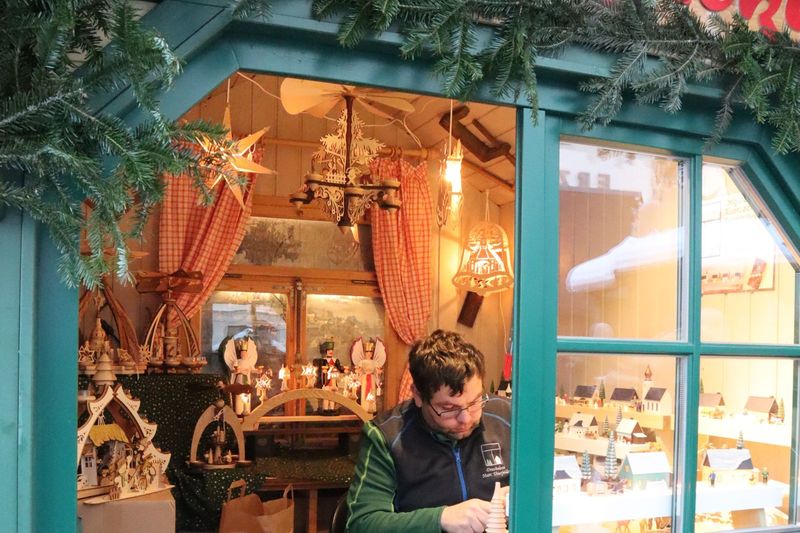
How much does a holiday market booth cost in 2026?
Booth fees in 2026 run from $10 a day to $40,000 a season, and the gap between the two ends is not explained by foot traffic alone. A survey of five US farmers market fee schedules checked on October 1, 2026 found daily rates between $10 and $90. Damascus Farmers Market in Virginia charges $10 a day or $250 for the season. East Lansing in Michigan charges $30 a day, $440 for the season, plus $5 a day for electricity. Park City in Utah charges non-farm vendors $60 a day in early summer and $90 in peak season, with a $120 application fee on top.
Dedicated holiday and craft markets sit in the middle. Registration runs about $50 for a one-day event and climbs to $300 or more for larger or extended markets. Juried shows add application fees of $30 or more on top of booth fees starting around $400.
Then there’s the flagship tier. Snowport in Boston’s Seaport charges $7,500 to $28,000 depending on booth size, and in the 2025 season the operator introduced a new model where vendors pay either the minimum rent or a set percentage of total sales, whichever is greater. Bryant Park’s Bank of America Winter Village charges $22,500 to $40,000 depending on size and location, plus electrical fees, according to figures Urbanspace shared with Retail Brew. For that money a vendor gets at most 12 square feet of booth space and access to roughly 4 million visitors over the season.
Urbanspace’s vendor page says Bryant Park applications for 2026 are already closed, and that Union Square welcomes 185 vendors while Bryant Park runs 180 or more. These are curated slots, not open rentals.
The three tiers of holiday market and who each one pays
Treating “holiday market” as one category is what gets vendors into trouble. There are three distinct businesses here, each with its own cost structure, risk profile and kind of seller it rewards.
| Tier | Typical cost | Commitment | Main risk | Best for |
|---|---|---|---|---|
| Local and farmers markets | $10 to $90 a day, or $250 to $1,300 a season | One day at a time | Low ceiling on revenue | Testing products and pricing with almost no downside |
| Curated regional holiday markets | $50 to $300 or more per event | A weekend to a few weeks | Audience mismatch and weak turnout | Established makers with a proven category and repeat buyers |
| Flagship city markets | $7,500 to $40,000 a season | Seven to ten weeks, paid up front | Fixed cost owed regardless of sales | Brands with inventory depth, staff and working capital |
The third tier is a different instrument from the other two. A $45 Saturday at St. Johns in Portland is an experiment. A $20,000 Snowport season is a fixed bet on one eight-week window, paid before the first customer arrives, and it doesn’t care whether December turns out warm or the subway floods.
There’s a fourth model worth knowing about, and it inverts the risk. Made in NYC’s shared booth at the 2026 Union Square Holiday Market charges no booth fee. Selected vendors get a seven-day residency between November 12 and December 24 and pay Urbanspace 15% of net sales afterward. Vendors must sell through Square or Shopify so the percentage can be tracked. Pay-on-performance pricing like this is rare, and it’s the single best structure for a seller who hasn’t proven a category yet.
The breakeven number most vendors never run
The number that decides whether a booth works is booth fee divided by contribution margin, and it takes thirty seconds to calculate. Gross margin on handmade goods commonly runs around 60%, meaning 40% of the retail price goes to materials. Card processing takes another slice: Square charges 2.6% plus 15 cents on in-person taps and dips at its free tier. That leaves about 57.4 cents of every dollar to cover the booth.
Run that against real fees and the picture gets clear fast.
| Booth fee | Gross sales needed to break even | What that looks like in practice |
|---|---|---|
| $10 a day | $18 | Two or three small sales |
| $90 a day | $157 | A slow day still clears it |
| $300 event fee | $523 | Comfortably inside an average day |
| $1,300 season | $2,265 | Roughly four average market days |
| $7,500 half booth | $13,066 | About $261 a day across 50 days |
| $20,000 typical booth | $34,843 | About $697 a day, every day |
| $40,000 premium booth | $69,686 | About $1,025 a day across 68 days |
Set those daily bars against the revenue bands above and the flagship tier stops looking like a prize. Snowport’s 2025 season ran November 7 to December 28 with Thanksgiving and Christmas closed, which is 50 selling days. A vendor carrying the typical $20,000 booth needs about $697 a day for all 50 just to reach zero. That’s the top of the “average day” band for seven straight weeks, with no slow Tuesdays allowed.
Bryant Park is steeper. Its Holiday Shops run October 28, 2026 through January 3, 2027, which is 68 days. A $40,000 booth needs roughly $1,025 a day across all of them. That’s a strong day, every day, for ten weeks. Few vendors sustain that.
A useful rule falls out of this: if the booth fee is more than 15% of what a vendor realistically expects to sell, the event is probably a loss. That threshold is why the same seller can profit at a $45 market and lose $12,000 at a famous one.

What vendors spend after the booth fee
The booth fee is rarely more than two-thirds of the real cost at the flagship tier. At Snowport, booths arrive as bare plywood, and vendors pay for lights, paint, display tables, decorations and the labor to assemble it all inside a three-day setup window. Off-site storage in a pod adds about $1,800. Add insurance, wages, packaging and moving, and total vendor cost passes $30,000.
Smaller markets have their own stack. Application fees of $30 to $120 are common and usually non-refundable. Electricity is often billed separately, at $5 a day in East Lansing. Card hardware starts around $59, and a seller’s permit and liability insurance are frequently required before an application is even accepted.
Time is the cost nobody prices. Sairey Gernes, who founded the travel apparel brand Urban Undercover, described the full cycle to Twin Cities Business: prep time, packing the car, working the event, tear down, then putting everything away at the office. A $300 weekend market can easily consume 30 hours once setup and teardown are counted, which means a $900 weekend pays about $20 an hour before materials. That’s a number worth comparing against whatever else those hours could earn, the same way GreyJournal’s look at what indie hackers actually make separates gross revenue from hourly return.
What the $100,000 season figure actually means
The number that pulls sellers toward expensive booths deserves a close look. Berthiaume’s estimate that vendors at the Dayton’s Project can make $100,000 to $200,000 over a season is real, and it’s also the most frequently stripped-of-context figure in this whole category. It describes top performers at a single flagship Minneapolis market during its strongest years, and it’s an estimate from a curator rather than audited vendor data.
Context helps. The Dayton’s Project Winter Maker’s Market launched with 28 vendors, grew to 47 local brands in 2022, and opened its 2023 season with 78. A $100,000 to $200,000 season belongs to a handful of those sellers, typically brands that already had retail distribution. Worker B, founded by Michael Sedlacek, had a Mall of America store years before the market existed.
Set that against the Institute for Justice median of $500 in annual profit and the distribution comes into focus. Holiday market income is power-law shaped, not normally distributed. A small number of established brands take most of the money, and the median seller is running a very small business that mostly pays for itself.
This is the same pattern GreyJournal found in haunted house economics and in how Americans estimate startup costs: the publicized number comes from the top of the distribution, and the planning number should come from the middle.
Is a holiday pop-up market booth worth it for a small business?
For most small businesses, yes at the local and regional tiers, and only conditionally at the flagship tier. The case isn’t purely revenue. Mahogany Ellis-Crutchfield, who founded the wrapping paper brand GiftyWrap, told Twin Cities Business there’s nowhere else to get that kind of direct customer contact when you’re first starting, and framed markets as a rung on a ladder rather than a destination. Sedlacek added that markets keep a brand visible in a way paid channels don’t.
The demand backdrop is strong this year. The National Retail Federation forecast on October 15, 2026 put November and December retail sales at $1.013 trillion, up 4.2% over 2025. More money is moving. It doesn’t move evenly to every booth.
Three conditions decide it. The breakeven math has to clear with room, meaning a booth fee under 15% of realistic expected sales. Average order value has to match the fee tier, since a stall selling $5 items needs an impossible transaction count to cover a $300 fee while one selling $200 pieces clears it in three sales. And the vendor needs a reason to be there beyond revenue, whether that’s email signups, wholesale leads or product feedback, because that’s what turns a breakeven weekend into a worthwhile one.
Flagship markets fail a fourth test for most sellers: working capital. Paying $20,000 up front, stocking inventory to match and staffing seven days a week for two months is a commitment on the order of starting a mobile bar or a small cold plunge studio, with none of the year-round revenue. Vendors who treat it as marketing spend they can afford to lose tend to do fine. Vendors who treat it as guaranteed December income get hurt.
The sequence that works is boring and effective: start at the $10 to $90 tier to find out what sells, graduate to $300 curated markets once a category proves itself, and only consider a flagship booth after a brand can show it clears four figures a day somewhere else first. That’s the same staged approach behind low-cost franchise entry and the side-stacking model, and it applies cleanly here. A holiday pop-up market is a test before it’s a business, and the vendors who treat it that way are the ones still selling in January.