
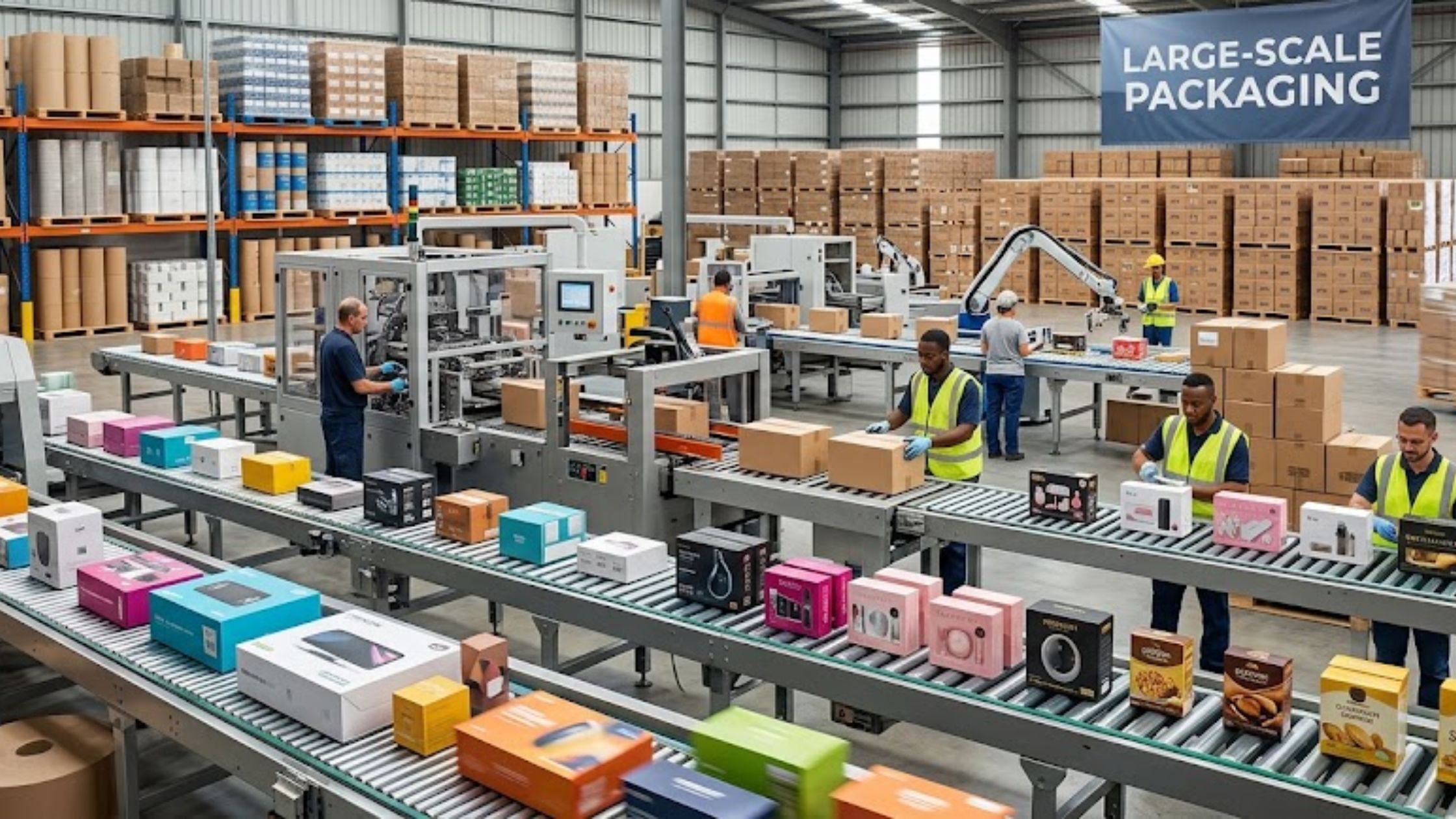
Launching a 10,000-unit run turns packaging from an experiment into a line-item risk. One barcode error can freeze five-figure inventory and trigger awkward calls from retail buyers. We’ve sifted supplier data, Reddit cautionary tales, and trade-journal reports to surface five partners built for this scale, not the starter-kit crowd.
Quick answer:
Zenpack, Oliver Inc., ePac, EcoEnclose, and PakFactory each dominate a niche: integrated multi-material programs, premium U.S. cartons, lightning-fast digital pouches, high-recycled paper, and broad global sourcing. Match each specialty to your specs, lead time, and compliance goals to unlock the lowest landed cost.
The best packaging companies at a glance
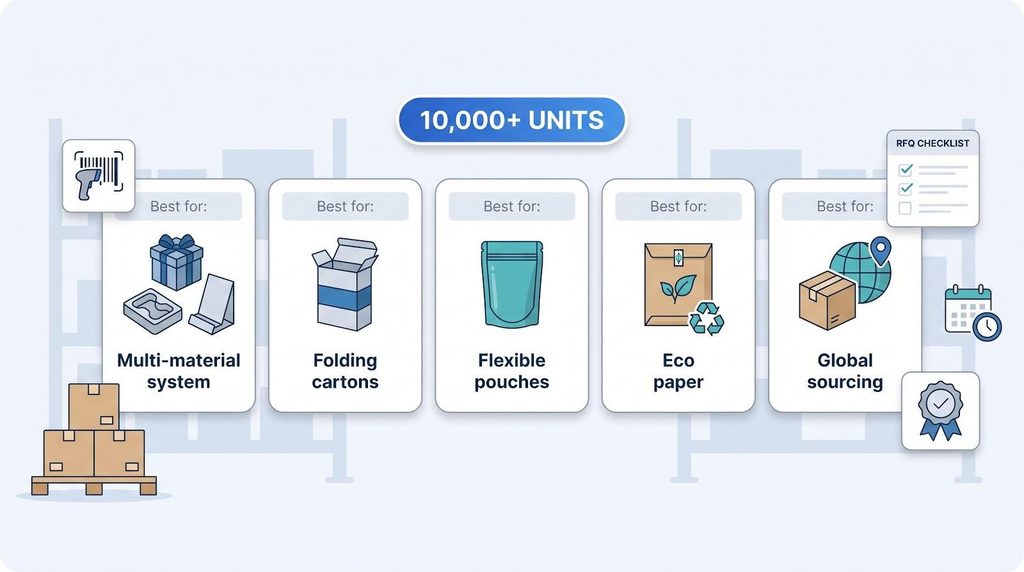
Snap a screenshot of this table to brief your team; it distills the five suppliers, their sweet spots, and the first red flag to raise in any RFQ.
| Company | Best for | Key formats | 10k evidence | Published lead * | Public pricing | Primary caveat |
| Zenpack | Integrated, multi-material programs | Cartons, rigid boxes, inserts, displays | FAQ notes 10k is the economic sweet spot | 15–24 weeks, design to production (FAQ) | No | Request plant-level certificates and firm lead time |
| Oliver Inc. | Premium U.S. folding cartons | Folding and rigid cartons, labels | Five U.S. plants with offset capacity | Quote only | No | Paperboard focus; no pouches |
| ePac | Fast flexible pouches | Stand-up, lay-flat, rollstock | Low-minimum digital runs, no plate fees | 10–15 business days | Instant for standard online sizes | Flexible only; cartons require another vendor |
| EcoEnclose | Paper-based sustainability | Corrugated mailers, cartons, tissue | Inline custom route activates at 10k | Quote only | No | Limited barrier options for food or liquids |
| PakFactory | Broad-format global sourcing | Cartons, pouches, rigid, molded pulp | MOQ table lists 10k for several SKUs | Quote only | No | Actual plant location and Incoterms vary |
*Published lead time begins after artwork approval and excludes freight.
Tables answer only half the question. Next, you’ll see why reaching the 10-thousand-unit mark rewrites everything from tooling math to EPR compliance.
What changes when you order 10,000+ units?
You’re buying a production system, not just a box
At 10,000 units, packaging, printing, and freight lock together like gears. A slick render means little if the cutting die drifts or the freight class inflates your landed cost.
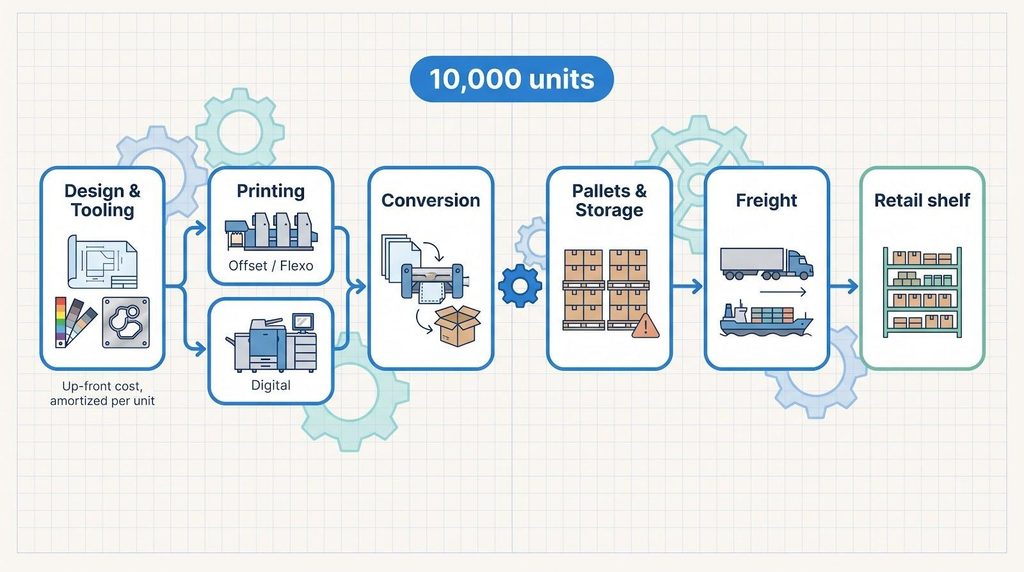
Tooling now drives the budget. Offset plates, cutting dies, and custom fixtures are paid up front, then spread across every unit, so one misstep multiplies into thousands of dollars.
Analog versus digital printing flips, too. One artwork at 10,000 units usually favors offset or flexo. Split the run across five SKUs and digital’s plate-free model can win on speed and cash; ePac, for example, advertises no plate fees and 10- to 15-day turnaround for flexible formats.
Inventory risk rises fast. A standard 48 × 40-inch pallet holds roughly 30–140 retail cartons depending on size; 10,000 cartons often consume eight or more pallets and real warehouse rent. If the formula or design changes, leftover stock becomes prepaid landfill, which is why seasoned buyers negotiate split deliveries and tight version control in every RFQ.
The landed-cost formula (and why factory price fools you)
Landed cost per unit = manufacturing price
- (tooling ÷ units)
- (proofing / QA ÷ units)
- (freight ÷ units)
- (duties ÷ units)
- assembly, warehousing, and EPR fees
- expected spoilage.
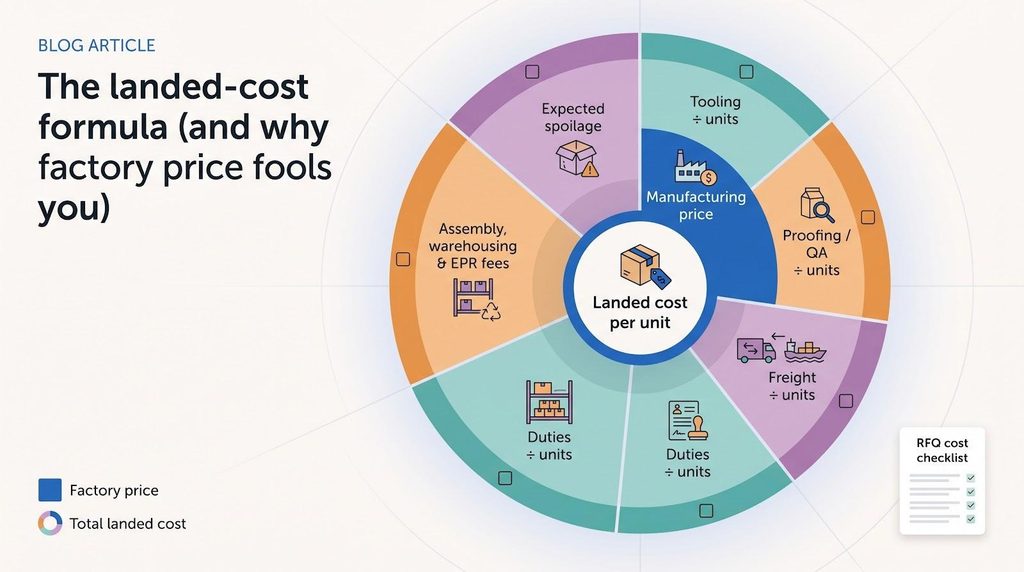
Freight shocks many first-timers. Ocean lanes protect margin but add weeks; air can exceed the carton’s value if dimensions creep. Add producer-responsibility fees, live in Oregon since July 2025 and arriving in more states, and the gap between “factory price” and “total bill” widens further.
Treat the formula like a checklist. If a supplier leaves a field blank, that cost still lands somewhere, usually on your statement later. Next, you’ll see how each supplier performed on the factors that move this formula in, or out of, your favor.
How we evaluated packaging companies for a 10,000-unit launch
Our scorecard targets the headaches that appear once you green-light a five-figure run:
| Criterion | Weight |
| 10,000-unit manufacturing fit | 20 percent |
| Format breadth and turnkey services | 20 percent |
| Speed and supply-chain resilience | 15 percent |
| Quality systems and compliance | 15 percent |
| Sustainability and EPR readiness | 15 percent |
| Cost-transparency signals | 10 percent |
| Verifiable retail track record | 5 percent |
This framework shows exactly which levers, speed, sustainability, or transparency, set one vendor apart from another instead of relying on marketing gloss.
Evaluation criteria
- 10,000-unit manufacturing fit (20 percent)
- Format breadth and turnkey services (20 percent)
- Speed and geographic resilience (15 percent)
- Quality systems, testing, and retail compliance (15 percent)
- Sustainability and EPR-ready documentation (15 percent)
- Cost transparency, including tooling, freight, and quote validity (10 percent)
- Verifiable retail track record (5 percent)
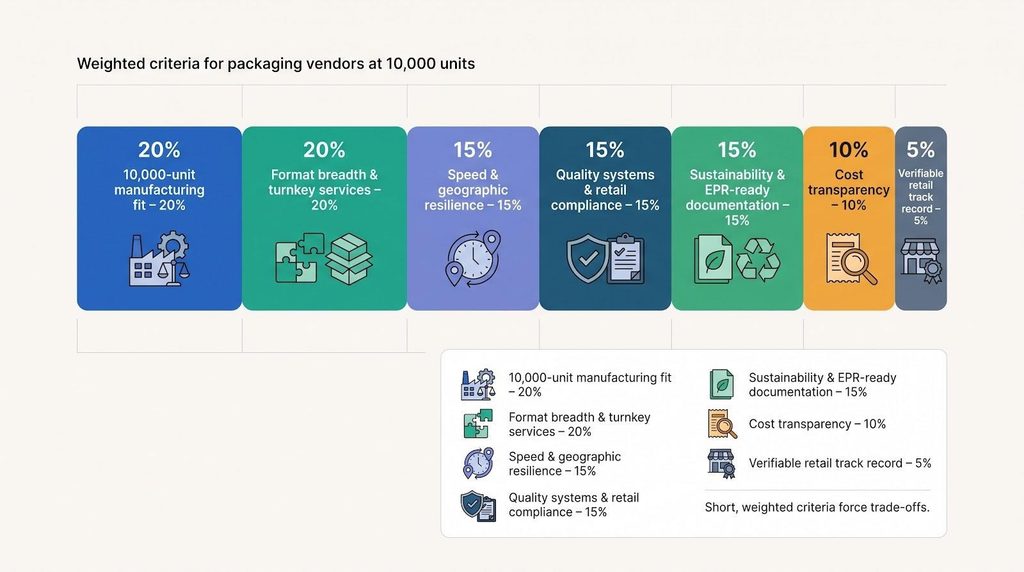
Short, weighted criteria force trade-offs. A beautiful carton means little if the factory misses the shelf date.
How we weighted evidence
We graded every data point:
| Grade | What counts | Examples |
| A | Public, dated, facility-specific proof | ISO 9001 certificate listing the plant address; SEC filing; official product page with SKU-level specs |
| B | Company-wide claim or reputable trade coverage | Corporate sustainability report; Packaging Dive article quoting the manufacturer |
| C | Sponsored, anonymous, or anecdotal source | Vendor-authored listicle; unsourced Reddit comment |
When a fact was unavailable, we marked it not public. Suppliers then see which blanks to fill in an RFQ, and you avoid “precision” that collapses under audit.
With the ground rules set, let’s meet the first supplier on the list.
1. Zenpack – best overall for integrated, multi-material launches
Zenpack works like a packaging general contractor, and its product launch packaging roadmap lays out a backwards-planned critical path, from discovery through tooling lock and pack-out, so every carton, insert, and retail display converges on the promised shelf date.
Zenpack product launch packaging roadmap website screenshot.
Why it made the list
The team designs the entire system, carton, insert, display, and the transit master pack, then assigns each piece to a plant in its managed network that can hit your spec, volume, and shelf date.
The company FAQ notes that 10,000 plus units is typically the most economical tier for standard custom work. The process assumes production-scale tooling and freight realities from day one, which is critical when a rigid box, molded-pulp insert, and foil-stamped sleeve must arrive in the same week.
Because a program manager sits between your artwork and multiple presses, you can pursue premium finishes without locking into one converter. Need a litho-lam display to match an offset carton? They source both, manage color tolerance, and combine freight before the retailer receiving window opens.
The result: one brief, one approval stack, and a launch kit ready for retail, e-commerce, or both, without last-minute supplier hunts.
2. Oliver Inc. – best for premium U.S. folding cartons
Why it made the list
Oliver operates five U.S. plants dedicated to paperboard packaging, so cartons print and finish close to the market they serve. Offset presses handle long runs, while digital presses support pilots and refreshes without plate fees, keeping color consistent across every reorder.
The compliance stack is deep: ISO 9001 for quality, G7 for color, SQF for food safety, and chain-of-custody certificates (FSC, SFI, PEFC) for fiber sourcing. Decorative options sit under the same roof: hot and cold foil, embossing, specialty coatings, and windowing. One approval, one press OK, and the carton ships shelf-ready.
For beauty, nutraceutical, or premium snack launches, a domestic footprint removes weeks of ocean lead time and slashes damage risk. You also avoid tariff swings and can schedule split deliveries from a plant in the same freight zone as many U.S. 3PLs.
What to watch
Pricing and MOQs are quote only. Ask for breakpoints at 10,000 and 25,000 units and how tooling is amortized. Confirm which Oliver site will run the job and request that plant’s certificate numbers. If you need flexible pouches or molded inserts, pair Oliver with another vendor, because the focus stays on cartons and rigid boxes. Oliver shines when carton quality defines brand perception.
3. ePac Flexible Packaging – best for pouches and multi-SKU launches
ePac Flexible Packaging stand-up pouches website screenshot.
Why it made the list
For stand-up pouches, ePac trades plates for pixels. Its network of HP Indigo digital presses removes plate fees and locks in 10- to 15-business-day lead times: 10 days for rollstock, 15 for finished pouches, once artwork is approved. Minimums are low, and standard pouch sizes can be ordered online.
Digital printing keeps color tight across every flavor or seasonal variant. If your launch needs five SKUs at 2,000 units each, the press queues them back-to-back without cylinder swaps, flattening setup cost and sparing your ops team.
Food and nutraceutical brands gain extra assurance: ePac’s Boston plant holds SQF food-safety certification, the first in its network. Sustainability options, recyclable PE films and PCR blends, are available with a custom quote. Request barrier data, seal performance, and recycled-content percentages in writing; regulators care about numbers, not slogans.
What to watch
ePac focuses on flexible films, so you’ll still need a carton or molded tray supplier if your launch demands them. Film choice drives cost because matte tactile or high-barrier laminations add dollars and days. Confirm freight class early; pouches nest efficiently, but rollstock diameters can increase shipping weight.
4. EcoEnclose – best for paper-based sustainability
EcoEnclose recycled paper-based packaging website screenshot.
Why it made the list
EcoEnclose built its name on recycled corrugated and kraft mailers, then scaled to inline production that starts at 10,000 units for retail boxes and other paper formats. Its shipping boxes are 100 percent recycled with 95 percent post-consumer content, and its Algae Ink option cuts the carbon footprint of the print, without putting cartons on an ocean journey.
Sustainability proof sits in public spec sheets: recycled-content percentages, mill certificates, and weight data drop straight into EPR filings now required in Oregon and slated for more states. When regulators ask for fiber origin or resin codes, you won’t be chasing a factory two time zones away.
EcoEnclose also thinks beyond the primary box. Matching tissue, void fill, and paper tape share the same recycled supply chain, so your unboxing story stays consistent and procurement issues one purchase order instead of three.
What to watch
Recycled paper falters with grease or condensation. If your product needs high barrier or lives in a refrigerated set, add a liner, pouch, or overwrap from another vendor. Cartonboard demand spikes can stretch lead times, so lock allocation early and confirm how long quotes hold. Finally, check pallet optimization: lighter recycled liners make cube efficiency, not weight, the freight driver.
5. PakFactory – best for broad-format global sourcing
Why it made the list
PakFactory offers folding cartons, rigid boxes, corrugated mailers, stand-up pouches, and molded-pulp inserts. Its public MOQ table lists 10,000 units for pouches and molded pulp, 1,000 for cartons, and 500 for rigid boxes. That lets you order the hero pack and its insert in one transaction.
The model blends an online configurator with managed production across a network of certified facilities worldwide. One portal, one account rep; PakFactory routes each component to the factory best suited for the material, finish, and run length. Launches juggling three or more formats save serious coordination time.
Digital proofs come before production, so brand managers can A/B cost-check spot UV versus foil or matte film versus soft-touch without losing calendar.
What to watch
Global sourcing carries extra variables. Always request Delivered Duty Paid and domestic-delivered quotes side by side to reveal freight, duties, and brokerage. Pin down the plant location and request its FSC, BRCGS, or ISO certificates; never settle for a corporate blanket statement.
Lead time depends on the lane. Ocean adds 30 days or more, so build slack or pay air on samples only. Confirm who owns the cutting die, mold, and print files; that leverage matters if you ever shift the job.
How to choose among the five companies
Start with one standard RFQ. Same specs, same quantities, same delivery ZIP code. Send it to all five suppliers, note who replies quickly, who answers every field, and who offers a smarter suggestion.
- Quote two volumes. Ask for 10,000 and 25,000 units so price breaks stand out.
- Specify the details. Include dimensions, board or film thickness, print coverage, finishes, launch date, and delivery address. Request both production lead time and transit time.
- Expose hidden costs. Tooling, freight, duties, color proofs, inspection fees, warehousing, and split-delivery surcharges can shift landed cost by double digits. Push back on every “TBD.”
- Probe risk controls. Where will the job run? Who owns the die and plates? What defect tolerance applies, and how is a reprint handled? Can the supplier provide material weights and certificate numbers for EPR filings? Get each answer in writing.
Run this checklist and one supplier usually rises to the top. The lowest factory price rarely wins; the clearest plan to protect margin and meet the launch date does.
Frequently asked questions
How much do 10,000 custom folding cartons cost?
A supplier-published example for folding cartons delivered duty paid to the continental United States ranges from USD 0.08 to 1.03 per unit for orders of 500 to 20,000 units, depending on box style, size, material, and finishes. Warehousing and waste sit outside that number, so treat it as a starting point, not a promise.
How early should packaging be ordered?
Work backward from the shelf date. Allow two weeks for structural design, one week for prototypes, one week for artwork tweaks, three to four weeks for production, and up to five weeks for ocean freight, or two weeks for domestic LTL. Add a buffer if you need retailer ISTA or drop testing.
Is domestic or overseas production cheaper?
Factory price often favors overseas plants, but total landed cost narrows once you stack freight, duties, insurance, and cash tied up in longer transit. Request side-by-side DDP and domestic-delivered quotes before deciding.
Offset or digital at 10,000 units?
If the full run shares one artwork, offset or flexo usually wins. Split the order across multiple SKUs or seasonal designs and digital’s plate-free model can edge ahead, especially when change control matters.
Which certifications matter?
For fiber sourcing, look for FSC, SFI, or PEFC. Color accuracy leans on G7. ISO 9001 covers quality systems, while BRCGS or SQF matter for food or nutraceutical work. Always ask for the certificate tied to the exact plant, not just corporate headquarters.
Conclusion
Ordering 10,000 or more units elevates packaging from a design exercise to an operational commitment. By matching your requirements to the specialty of Zenpack, Oliver Inc., ePac, EcoEnclose, or PakFactory, and by interrogating every cost in the landed-cost formula, you can protect margin, hit shelf dates, and stay compliant long after launch.


