

Time, not capital, is the scarcest resource in private equity. AlixPartners’ 2026 Private Equity Leadership Survey shows that 65 percent of PE firms replace a portfolio CEO during the holding period, with turnover spiking around year two, eroding months of compounding. This guide ranks seven executive-search partners so you can seat the right leader fast and keep your value-creation clock ticking.
The seven best firms at a glance
Deal teams ask for a single page, so here it is. Skim the grid, drop it into Monday’s partner deck, and flag any blanks for your RFP follow-up.
| Rank | Firm | Best for | Public speed metric† | Public quality metric† |
| 1 | ECA Partners | Fast cycle + interim cover | < 85 days average close (average 85-day search cycle) | 98 percent executive search retention |
| 2 | ON Partners | Partner-led alignment | Not disclosed | 98 percent 12-month retention; 12-month replacement guarantee |
| 3 | Bespoke Partners | Software / SaaS | < ½ industry-average time | 95 percent placement success |
| 4 | JM Search | Broad U.S. mid-market | Not disclosed | Net Promoter Score 78 (client-reported) |
| 5 | SPMB | Tech & growth equity | 80-100 days average | Not disclosed |
| 6 | Russell Reynolds | Global CEO succession | Not disclosed | Retention not publicly shared |
| 7 | Heidrick & Struggles | Complex cross-border mandates | Not disclosed | Retention not publicly shared |
†All metrics are firm-reported and unaudited unless otherwise noted.
Evidence thins out below the top three rows. Treat the blanks as to-dos: ask each firm for time to first slate, true 24- or 36-month stick rates, and any exclusions buried in replacement guarantees.
Now that you have the bird’s-eye view, we can unpack how we scored these firms, and why speed and retention outweigh brand cachet in an IRR model.
Time adds drag even when value stays flat
Hold the exit multiple at 3.0x and see how a longer calendar trims gross IRR:
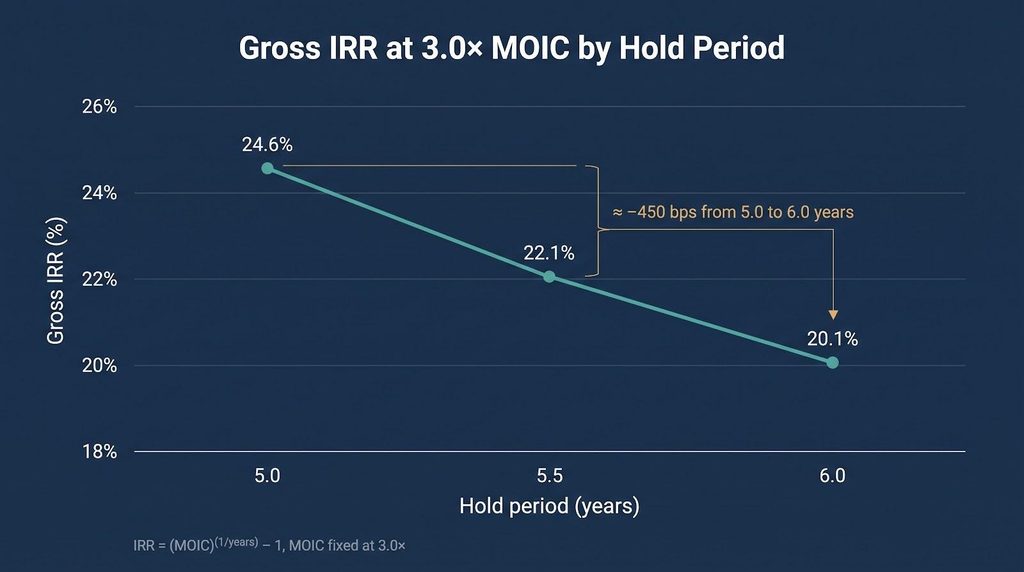
| Hold (years) | Gross IRR |
| 5.0 | ≈ 24.6 percent |
| 5.5 | ≈ 22.1 percent |
| 6.0 | ≈ 20.1 percent |
Formula: IRR = (MOIC)^(1/years) – 1
Those extra 250-450 basis points can separate top-quartile funds from the pack and shape your next capital raise. Vacancy days, offer declines, and do-over searches work like a quiet tax on returns, so choose partners who shorten the timeline. Speed isn’t impatience; it’s arithmetic.
One transition is manageable; two or more can break the clock
Illustrative: hold the exit at 3.0x MOIC and stretch the calendar the way repeated CEO resets do:
| CEO changes (illustrative) | Average hold (yrs) | Gross IRR at 3.0x MOIC* |
| 0 | 5.5 | ≈ 22.1 percent |
| 1 | 5.8 | ≈ 20.9 percent |
| 2 | 8.5 | ≈ 13.8 percent |
| 3 | 9.2 | ≈ 12.7 percent |
| 4 | 11.0 | ≈ 10.5 percent |
*IRR formula: (MOIC)^(1/years) – 1
A single, orderly swap might cost only a few months, but every extra reset extends the hold and erodes additional basis points. Tough deals often trigger churn, and churn can worsen the deal, so your safest move is to secure the right first hire and back that leader through onboarding and value-creation milestones.
1. ECA Partners: best for measurable speed and transition coverage
ECA shares its numbers openly: an average of under 85 days from kickoff to signed offer for permanent roles, an 18-day average for on-demand consultants in 2024, under a week for interim executives, and a 98 percent executive-search retention rate. Those figures turn time risk, the quiet IRR tax, into something you can underwrite.
The brief starts with the value-creation plan, not the résumé stack. Consultants map the EBITDA levers first, then reverse-engineer the traits the next leader needs to pull them, which shortens calibration calls and keeps the slate on brief.
Transparency fuels the speed story. ECA publishes its cycle-time and retention figures and cites more than 4,000 completed searches for private equity firms and their portfolio companies; ask to see the underlying counts for your role and sector. When you can audit the raw counts yourself, decisions move faster.
If vacancy days worry your board as much as missed covenants, put ECA on the RFP. Before you sign, confirm how many active mandates your lead partner is running and put the replacement-search guarantee in writing, including who pays travel and assessment fees the second time around.
2. ON Partners: best for partner-led alignment from kickoff to close
ON Partners makes one promise: the senior partner who answers your first call stays on every calibration, reference, and offer negotiation. That continuity keeps sponsor, board, and management voices in sync, saving weeks usually lost to hand-offs.
Evidence for the model is strong:
- 98 percent of placements still in role at 12 months and a 4.9 / 5 client satisfaction score
- 85 percent repeat client and 95 percent referral rates
- 12-month replacement search at no additional fee if the hire leaves for performance reasons
What’s missing is speed. Before you commit, ask for median days to first slate and to signed offer on searches like yours, and confirm how many live mandates your lead partner is juggling. Lock those milestones, along with the replacement terms, into the engagement letter. Alignment matters only if it arrives on time.
3. Bespoke Partners: best for software and SaaS portfolio companies
Bespoke works almost entirely in software and SaaS, with more than 1,400 senior executives placed across more than 400 software companies, so each search starts with a mapped universe of recurring-revenue operators. Consultants already track who scaled ARR from $50 million to $500 million, which CRO pushed net retention above 120 percent, and which CFO steered a carve-out through a clean Day-1 close.
Speed is the headline claim. Bespoke says its AI-based Executive Index trims time to placement by roughly 30 percent compared with traditional workflows and ranks 700,000-plus U.S. executives for growth-stage fit. Human partners still interview every candidate to test culture, sponsor dynamics, and appetite for equity, blending data acceleration with seasoned judgment.
Quality keeps pace. The firm reports a 95 percent placement-success rate and says its placed finance executives cut software-company hold periods by a third on average. If your thesis leans on usage-based pricing, product-led growth, or hyperscale integrations, Bespoke likely knows leaders who have done it twice.
Caveat: sector focus cuts both ways. Healthcare IT is probably covered; heavy industrials, less so. Ask for comparable placements at your revenue band and request evidence that the AI scores correlate with real exit results.
4. JM Search: best for broad North-American middle-market PE
JM Search has partnered with private-equity sponsors for 45 years, building a bench of CEOs, CFOs, and functional leaders who have scaled sub-$1 billion companies across healthcare, industrials, technology, and consumer sectors.
What sets the firm apart is partner stability and organic growth. The team has grown nearly 181 percent over the past five years, all of it organic, keeping market knowledge in-house and avoiding the hand-offs that slow large platforms. Clients reward that continuity with a Net Promoter Score of 78, rare advocacy in a world where sponsors seldom hand out compliments.
Speed metrics are private, so press for median days to first slate and signed offer on comparable roles, and ask for 24- and 36-month retention through exit, not just year one. If you need a seasoned PE specialist who can deliver a multisector slate without routing the brief through four practice groups, JM Search is the steady, partner-led option.
5. SPMB: best for technology and growth-equity mandates
Founded in San Francisco in 1977, SPMB is a retained executive-search firm that focuses on C-level tech placements. It grew up inside the Bay Area ecosystem and still benefits from that first-mover footing. The private-equity practice works side by side with growth funds buying founder-led software, fintech, and digital-health assets, companies where product speed often beats process.
Its recent field guide for private equity executive search firms distills four decades of experience into five litmus tests: demonstrable PE fluency, senior-partner accountability, sector depth, a transparent data-driven process, and a track record of speed backed by the time-to-close and retention figures you should ask every firm to produce. It gives sponsors a ready-made diligence checklist.
SPMB partners have cited an average 80-to-100-day cycle from kickoff to signed offer (Hunt Scanlon, 2024), and the firm’s own guides describe 60 to 90 days as typical. Partners run a process SPMB calls the 4×4: four qualified candidates in front of the client by the fourth week, and four kept in play every week after that, so the slate never collapses to a single option. That structure cuts the back-and-forth common in founder cultures wary of dilution.
Partner continuity is the hook: the lead you meet stays on every reference and offer call. The trade-off is bandwidth, so ask for the current load of live searches to see how much attention your mandate will receive.
Retention isn’t public, so add a clause that extends the replacement guarantee to exit or at least thirty-six months. If your thesis counts on product-led expansion, usage-based pricing, or rapid GTM, SPMB’s Silicon Valley roots can shorten both calibration and candidate persuasion.
6. Russell Reynolds Associates: best for global CEO succession and assessment
When a mandate spans continents or hinges on a founder’s first hand-off, sponsors often call Russell Reynolds Associates (RRA). The firm pairs a 50-year boardroom pedigree with one of the deepest assessment benches in executive search.
The Private Capital group begins each engagement with leadership due diligence that mirrors commercial diligence. That due diligence, assessment against the value-creation plan, and forensic referencing reveal whether a candidate can thrive under leverage, limited liquidity, and sponsor reporting cadence, and the same team supports the transition after the hire.
Research is RRA’s other edge. Its Global CEO Turnover Index tracks chief-executive transitions across major indices, evidence that consultants use to press for decisive action rather than drift.
Speed metrics aren’t public, so write milestone dates (calibration, first slate, finalist list) into the engagement letter, and request a full off-limits map to avoid late-stage conflicts. If your portfolio needs a global operator or a founder whisperer, RRA has the playbook, provided the timeline is as disciplined as the assessment.
7. Heidrick & Struggles: best for complex large-cap and cross-border mandates
When a mandate spans three continents and multiple regulators, sponsors often turn to Heidrick & Struggles (H&S). Founded in 1953, the firm runs one of the world’s largest private-equity search practices, operating out of more than 50 offices across six continents on its internal talent-intelligence platform.
That reach appears in cross-border shortlists, mixing U.S. operating discipline with European works-council fluency and Asian supply-chain expertise. The firm fields more than 500 consultants across 30 countries; its candidate write-ups read more like an investment memo than recruiter language and include risk flags, situational strengths, and onboarding prescriptions. The same team provides post-placement coaching to head off cultural misfires that can derail international exits.
Speed metrics are confidential, and the global client roster creates off-limits constraints, so diligence is critical. Ask for:
- A country-by-country off-limits map
- Current search load for your lead partner
- Median days to offer on mandates of similar size and complexity
- A replacement guarantee that extends beyond statutory notice periods in each jurisdiction
If your playbook involves taking a European carve-out global, rolling up APAC suppliers, or prepping a U.S.-listed spinout, H&S brings the board credibility and cross-border capacity to match. Just lock the timeline and candidate universe before kickoff.
Boutique or global: which model fits your portfolio company?
Size alone doesn’t guarantee fit. A global firm offers borderless reach, assessment labs, and a Rolodex that spans public boards, advantages when you’re carving out an EU division, hiring in three languages, or courting a buyer that prizes governance optics. The trade-off is slower consensus building and more off-limits conflicts; Heidrick & Struggles found in a study of 20,000 executive searches that 40 percent of executives hired at the senior levels are forced out, fail, or quit within 18 months, a risk that grows when off-limits lists shrink the talent pool.
Boutiques reverse the math. Partners speak the sponsor dialect, sprint to a slate, and live inside mid-market compensation bands. Because consultants handle fewer searches, boutiques can often close faster than large firms; ask each for its median kickoff-to-offer figure. What they lack in passport stamps, they repay with focus and fewer conflicts.
Ask two questions:
- Does this search demand cross-border credibility or calendar speed?
- Will a single named partner stay accountable, or do you need the redundancy of a 20-office network?
Answer them, and the right model usually announces itself.
How to run an executive-search RFP around the value-creation plan
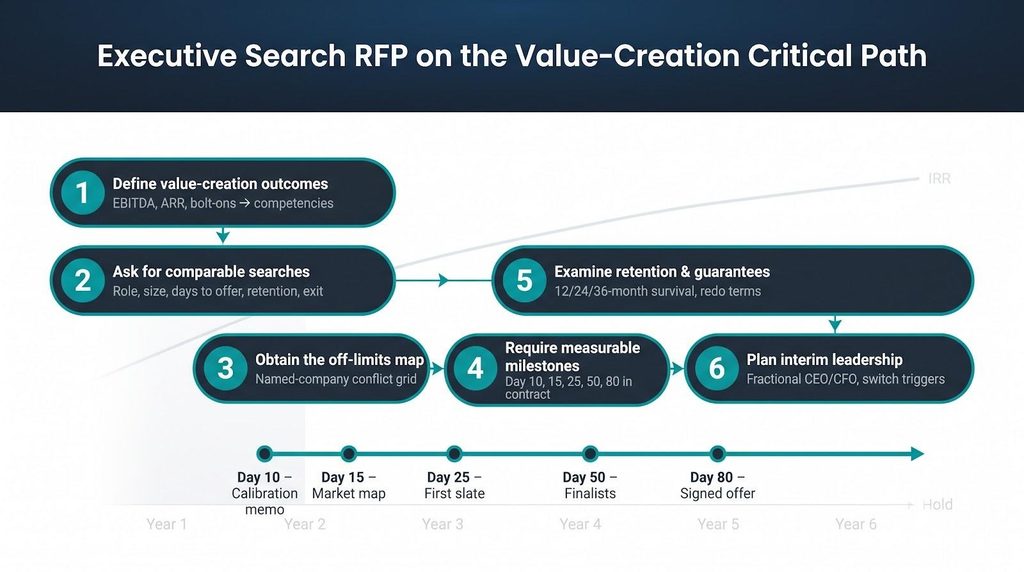
1. Define the value-creation outcomes
Start with the numbers. Does the thesis call for doubling EBITDA, lifting ARR by 40 percent, trimming working-capital days, or bolting on three acquisitions? Translate each target into required competencies, for example, a pricing uplift needs a commercial athlete who has raised net revenue per unit under pressure, while a carve-out needs a CFO who stood up new systems in fewer than nine months. Share entry multiple, leverage stack, and planned exit date so the recruiter can model IRR impact by month.
2. Ask for comparable searches, not famous logos
Request a table covering the past 24 months: role, company size, days to offer, 12- and 24-month retention, realized exit value. Patterns of on-brief success matter more than big brands.
3. Obtain the off-limits map early
Demand a named-company conflict grid during the pitch and update it every two weeks. Put the disclosure in the engagement letter so a late-stage conflict doesn’t restart the clock.
4. Require measurable milestones
Embed dated deliverables in the contract, such as a calibration memo (Day 10), market map (Day 15), first slate (Day 25), finalists (Day 50), and signed offer (Day 80). Tie a portion of the fee to these checkpoints so incentives match your timeline.
5. Examine retention and replacement terms
Ask for role-specific survival rates at 12, 24, and 36 months. Dissect the guarantee: triggers, duration, and who pays travel or assessment costs on the redo. Confirm whether onboarding support is included for year one.
6. Plan interim leadership before the clock starts
Vacancies will happen, so line up an interim option. Verify that the firm can place a fractional CEO or CFO within days, and spell out deliverables, such as a 90-day cash forecast or integration roadmap. Decide who can trigger the switch, ideally the operating partner or chair, to avoid two-week committee delays.
A well-structured RFP keeps the search on the same critical path as your value-creation plan: faster slate, tighter fit, preserved IRR.
Conclusion: red flags when choosing a PE executive search firm
Watch for these danger signals; each one can add months and unexpected cost.
- Disappearing partner: the senior voice from the pitch vanishes once the retainer clears.
- Hidden off-limits list: conflicts surface only after you fall in love with a finalist.
- Undefined speed claims: “record fast” without dates for first slate, finalists, or signed offer.
- Retention with no window: a “95 percent stick rate” means little unless you know whether it’s 12, 24, or 36 months.
- Open-ended expenses: low headline fee but research, travel, and assessments billed as vague “extras.”
- Data evasion: the firm ducks requests for historical cycle time, retention, or comparable searches.
If a consultant sidesteps hard numbers or written accountability, end the meeting. Time is IRR, and red flags never fade with age.


