

Private credit has quickly become one of the hottest topics in finance, yet many small business owners and everyday investors aren’t quite sure what it is. In simple terms, private credit refers to loans made by non-bank lenders directly to companies. These loans are privately negotiated and not traded on public markets. Over the past decade, private credit has exploded in size – growing from a niche corner of finance into a trillion-dollar market . This article will explain what private credit is, how it works, who uses it, and why it’s growing so fast in the United States. We’ll also explore its impact on businesses, the job market, and the broader financial system, and highlight recent developments that illustrate both its momentum and risks.
What Is Private Credit?
Private credit (also known as direct lending) means loans provided by investors or funds rather than traditional banks. Instead of a bank loan or a public bond, a company can borrow money from a private credit fund. These loans are negotiated in private between the borrower and the lending fund . Often the borrowers are small or mid-sized businesses that are too small to issue public bonds and may not qualify for strict bank loan standards . In other words, private credit steps in to serve companies that fall in the financing gap – not big enough for Wall Street’s bond market, but not a safe bet for the local bank.
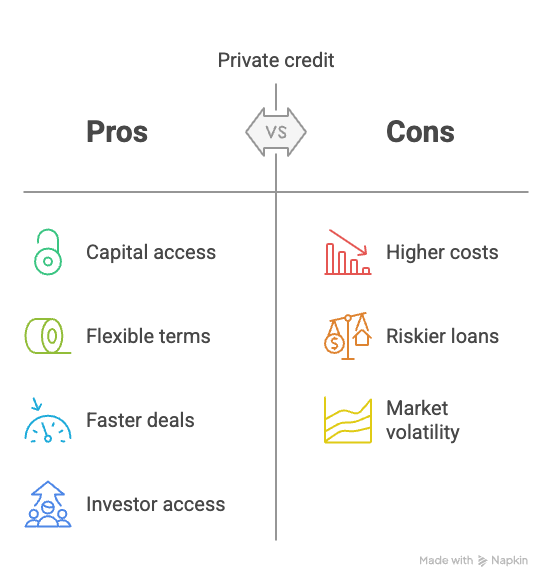
For borrowers, private credit is an alternative source of capital when bank loans are hard to get. The loans can be tailored to fit the business’s needs in terms of amount, repayment terms, and timing . Unlike a standard bank loan, a private credit deal might allow more flexible terms or quicker access to funds, negotiated case-by-case. However, because these loans are custom and often riskier, they typically come with higher interest rates (benefiting the lender with higher returns).
From the investors’ side, private credit is an investment in debt rather than equity. When you invest in private credit, you become the lender – you give a loan to a business and earn interest and fees in return . These investments are usually made through specialized funds. Historically, this was the domain of institutional investors (like pension funds, insurance companies, and endowments) and high-net-worth individuals, who commit money to private credit funds for several years. In exchange, they hope to earn higher yields than they could from regular bonds or savings accounts. For example, private credit often offers floating interest rates, so investors benefit as rates rise . Many private loans are also secured by collateral (assets of the borrower), adding a layer of protection for lenders.
How Does Private Credit Work?
In practice, private credit deals are structured a lot like loans you’d get from a bank – but with more flexibility. A private credit fund raises money from investors (like pensions, endowments, or wealthy families) and then directly lends that money out to companies. The fund conducts due diligence on potential borrowers’ finances and business plans, negotiates loan terms, and funds the loan. The loans can range from senior secured loans (first in line to be repaid) to mezzanine or subordinated debt, and often can be customized to the situation. For instance, a lender might offer a unitranche loan, which blends senior and junior debt into one facility for the borrower’s convenience. The key feature is customization: private lenders can set terms that fit a company’s unique needs – something standardized bank loans or bonds might not allow .
Once the loan is made, the private credit fund collects regular interest payments from the borrower (providing income to the fund’s investors) and eventually gets the principal repaid at maturity. These loans typically carry floating rates, meaning the interest adjusts with benchmarks – a perk for investors in a rising rate environment . The fund manager actively monitors the borrower over the life of the loan, often with covenants (financial conditions) in place to protect the lender . If the borrower runs into trouble (for example, missing payments), the private lender can work with the company to restructure the loan, or in worst cases enforce collateral or take other actions (sometimes even taking ownership of a stake in the company). This hands-on approach is why private credit managers often hire not just credit analysts but also restructuring specialists and even former operators who can step in if a company needs help turning around .
It’s important to note that private credit investments are illiquid – unlike stocks or bonds, you can’t easily sell these loans on a public exchange. Investors usually lock up their money for years until the loans are repaid. In return for giving up liquidity, investors seek an “illiquidity premium,” meaning a higher return than liquid markets offer . This structure (long-term committed capital) also means private credit funds aren’t vulnerable to a sudden investor run-off like a bank might be; fund investors can’t just withdraw money on a whim – they have to wait for the loans to be paid back .
Who Uses Private Credit (Borrowers and Investors)?

Borrowers: The typical borrowers in private credit are businesses that need capital but can’t (or don’t want to) go through banks or public markets. These are often middle-market companies – for example, a manufacturing firm or a tech services company that might have annual revenues in the tens or hundreds of millions, not big enough to issue bonds. They might be highly leveraged (carrying debt) or otherwise not meet bank lending criteria . Some are owned by private equity firms who need quick financing for acquisitions or expansions. Private credit has been especially popular for companies backed by private equity sponsors doing leveraged buyouts or growth investments. For these firms, private credit offers a way to get large loans quickly, with more flexibility on terms (albeit at a higher cost). A good example was in 2023, when a group of private lenders provided a record $5.3 billion loan to Finastra (a financial software company) to refinance its debt – this direct loan deal was the largest ever in the U.S., underwritten by about 15–20 non-bank lenders working together . Such a deal shows how even sizable companies are tapping private credit when banks balk at the risk or timeline.
For borrowers, speed and certainty are big advantages. Private credit funds often advertise their ability to close deals faster than traditional banks and to offer more tailored financing solutions . For example, a company needing a creative financing package – maybe combining a loan with an equity kicker, or needing a customized repayment schedule – might find private funds more willing to craft that deal. Also, private loans often come with less bureaucracy; there’s no lengthy public issuance process as with bonds. The trade-off is cost: interest rates on private credit are generally higher than bank loans, reflecting the higher risk and bespoke nature. But for a company that needs money when banks are saying no, the cost may be worth it to access growth capital or refinance debt.
Investors: On the other side, the money for private credit largely comes from institutional investors and high-net-worth individuals seeking better yields. After the 2008 financial crisis, with interest rates near zero, big investors like pension funds, insurance companies, endowments, and family offices started “reaching for yield” and found private credit attractive . As of recent data, more than two-thirds of the capital in U.S. private credit funds comes from pensions, nonprofit endowments, and wealthy families . These investors are willing to tie up money for several years in exchange for higher interest income. They view private credit as a way to diversify their portfolios and earn returns that often beat public bond benchmarks. In many cases, private credit yields can reach high single digits or low double digits, which is compelling in a low-yield world.
What about everyday investors? Traditionally, private credit was off-limits to retail investors because of high minimum investments and long lock-ups. However, that is changing slightly. There are now publicly traded vehicles called Business Development Companies (BDCs) that function like “retail” private credit funds. BDCs are companies that invest in small- and mid-sized business loans, and individuals can buy shares of BDCs (some are listed on stock exchanges, others are non-traded) . This gives regular investors a slice of the private credit market. In fact, BDCs have grown rapidly and now account for roughly 14% of the entire private credit market . They offer high dividend yields (funded by the interest the BDC earns from its loan portfolio), making them popular among income-seeking investors. Apart from BDCs, accredited investors can also access private credit through certain interval funds, private credit mutual funds, or fintech platforms that pool smaller investments to make private loans. The key point is that while private credit remains dominated by big institutions, there are avenues for smaller investors to participate – albeit usually with some limitations and risks.
Why Is Private Credit Growing So Fast in the U.S.?
Private credit’s rapid rise, especially in the U.S., is driven by a perfect storm of supply and demand factors:
Banks Pulling Back: In the wake of the 2008 Global Financial Crisis, banks faced stricter regulations and capital requirements that made business lending tougher for them. Over the past decade, many banks have reduced their exposure to riskier corporate loans and become pickier about whom they lend to . This created a financing void – businesses still needed loans, but banks were less willing to provide them. Private credit funds rushed in to “fill the gap” left by banks . More recently, events like the 2020 pandemic shock and 2022’s rising interest rates caused banks to tighten credit further, which only increased companies’ reliance on alternative lenders. In essence, when traditional banks take a back seat, private credit steps on the gas.
Investor “Reach for Yield”: On the flip side, the past decade saw very low interest rates, meaning traditional fixed-income investments (like Treasurys or investment-grade bonds) yielded very little. Large investors such as pension funds and insurers still need to meet return targets (to pay pensions or insurance claims), so they started looking for higher-yield opportunities. Private credit, with its floating-rate loans and often double-digit interest rates, became an attractive option. This surge of investor money flowing into private credit funds gave them the firepower to grow quickly. For example, BlackRock (a major asset manager) projects that private credit globally will exceed $3.5 trillion by 2028 at current growth rates . In the U.S. in particular, private credit outstanding jumped from about $40 billion in 2008 to roughly $630 billion by early 2023 – a more than 15-fold increase . This growth was fueled by investors’ appetite for better returns as well as the expanding number of borrowers seeking loans.
Speed and Flexibility: Private credit’s competitive advantages over traditional lending also drive its adoption. Private funds tout their ability to close deals faster and offer customized loan structures (covenant-lite loans, PIK interest, unitranche facilities, etc.) that banks either can’t do or won’t do. For a company needing quick certainty (say, to finance an acquisition within weeks), a private credit fund can assemble a loan quickly, whereas a bank syndicate might take longer or impose more conditions. This responsive, bespoke approach has led some to call the current environment a “golden age of private credit” . Even large private equity firms (which traditionally relied on banks to finance their buyouts) are increasingly turning to private credit “club deals” – where a handful of direct lenders team up to fund a multi-billion-dollar loan. The Finastra deal mentioned earlier is one such case, highlighting that private credit is no longer just for small companies – it’s now competing head-to-head with Wall Street banks for big financings.
Regulatory and Market Shifts: U.S. regulators are considering higher capital requirements for banks (to bolster bank stability). Ironically, banks argue that this will make them even more reluctant to lend, pushing even more business to private credit funds . At the same time, public debt markets (like high-yield bonds) can be volatile and expensive during uncertain times, so companies may prefer the certainty of a privately negotiated loan. All these factors have contributed to private credit’s fast growth. In numbers: the global private credit market grew from about $375 billion in 2008 to over $1.6 trillion by 2023 , with the U.S. being a huge driver of that trend.
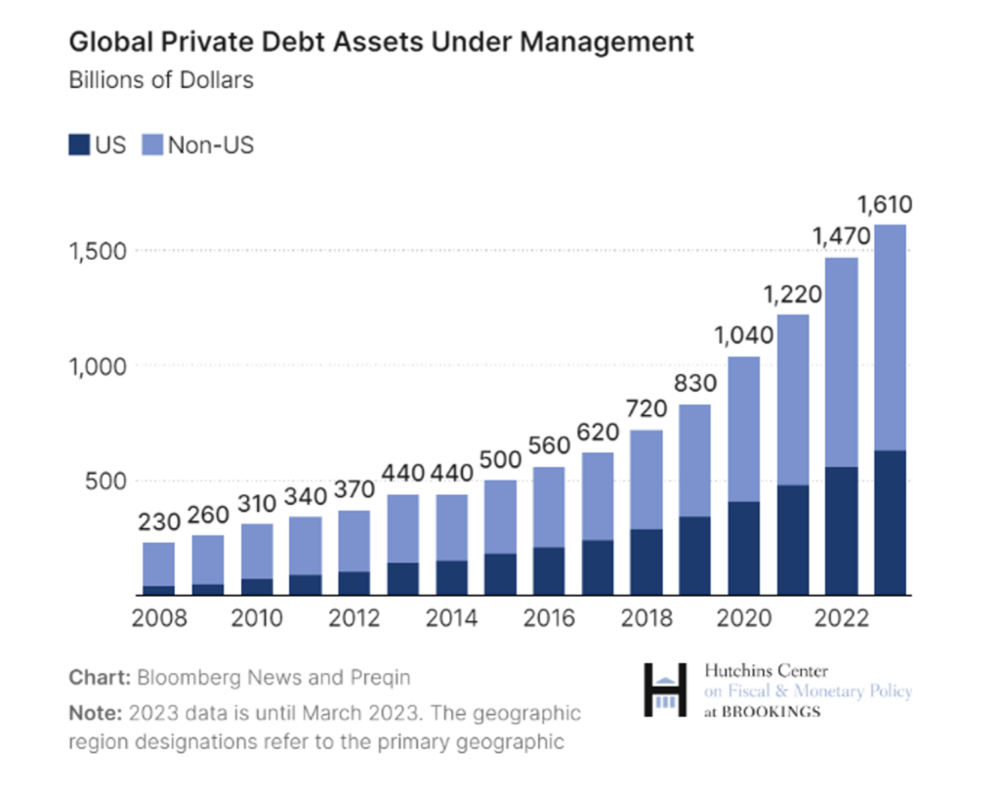
Global private credit assets under management have risen dramatically in the past decade. The United States (dark blue) now makes up a large share of this market . (Source: Hutchins Center on Fiscal & Monetary Policy at Brookings)
This growth has been so rapid that traditional finance players have taken notice. Wall Street giants like Goldman Sachs have launched or expanded their own private credit funds – for instance, Goldman recently raised $21 billion for a private credit pool, its largest ever . Meanwhile, specialist firms dedicated to private credit keep attracting capital. The momentum shows no sign of slowing as long as investors seek yield and borrowers seek capital.
The Scale of the Private Credit Market
To put things in perspective, let’s look at the scale of private credit today. As of the start of 2024, the global private credit market was about $1.5–1.6 trillion in assets (loans outstanding) . This is a small but rapidly growing slice of the overall business lending landscape. By comparison, total non-financial business debt in the U.S. is over $21 trillion (including corporate bonds, bank loans, etc.), and U.S. banks alone held about $2.7 trillion in commercial loans at the end of 2023 . So while private credit is still relatively small next to banks and public markets, it’s become influential at the margins – especially for mid-sized companies and leveraged finance.
The U.S. has become the epicenter of private credit. In 2008, U.S. private credit was only around $40 billion . Fast-forward to 2023, and U.S.-focused private credit funds manage hundreds of billions (over $600 billion by some estimates) . About 40% of all private credit investment is in the U.S. (Europe is the second-largest region) . Moreover, out of the world’s largest private credit managers, an overwhelming majority are U.S.-based . This American boom is tied to the factors we discussed – deep capital markets, many mid-sized firms needing funding, and banks pulling back post-crisis, leaving a gap for private lenders.
Crucially, private credit is not one homogenous thing – it spans various strategies. The largest category is direct lending, which typically means senior loans to middle-market companies (this makes up roughly 40-50% of private credit AUM) . Other segments include mezzanine debt (subordinated loans often with equity kickers), distressed debt (buying or lending to troubled companies in hopes of a turnaround), asset-backed lending (loans backed by specific collateral like real estate or receivables), and special situations (highly customized, event-driven financings) . But the common thread is that all these are credit investments outside the public market, usually held in private portfolios.
To appreciate the scale and key players, the table below lists some of the major private credit firms in the U.S. and their approximate assets under management (AUM) dedicated to credit, as well as their focus areas:
| Firm | Approx. Private Credit AUM | Focus Areas |
|---|---|---|
| Apollo Global Management | ~$480 billion | Large corporate loans, distressed debt, specialty finance (non-traditional lending) |
| Blackstone (Credit & Insurance) | ~$465 billion | Direct lending (middle-market senior loans), opportunistic credit, CLOs/structured credit |
| Ares Management | ~$359 billion | Middle-market direct lending, syndicated loans, asset-based lending, special situations |
| Oaktree Capital | ~$143 billion | Distressed debt and turnaround lending, high-yield debt, value-oriented credit investing |
| Blue Owl Capital | ~$31 billion | Middle-market direct loans, unitranche financing, senior secured loans to sponsor-backed companies |
Table: Major private credit players in the U.S., with their estimated assets under management (dedicated to credit strategies) and their known areas of focus. (AUM figures as of 2023–2024)
These firms represent the vanguard of private credit. Notably, Apollo, Blackstone, Ares, KKR, and Carlyle – all giants of private equity – have become powerhouses in private lending as well . In fact, Apollo’s CEO described private credit as the “future” of asset management, underlining how central it has become to their growth plans . Specialized credit firms like Oaktree (famous for distressed investing) and Blue Owl (which emerged from a merger of Owl Rock Capital and Dyal Capital) are also key players, focusing heavily on lending to mid-sized companies.
For borrowers, this means there is now a large pool of non-bank capital available – if one private lender can’t do a deal, another might, or they might team up. For investors, it means a wide range of funds and strategies to choose from when allocating to private credit.
Private Credit in Everyday Business Life
How is the private credit boom being felt on Main Street and in everyday business? One clear impact is greater access to capital for companies that historically struggled to get loans. A decade or two ago, a company with an ambitious expansion plan but no luck with banks might have been out of options. Today, that company could approach a private credit fund or a BDC that specializes in its industry or size range. In this way, private credit has become an alternative financing lifeline for many businesses.
For example, imagine a family-owned food manufacturing business that’s grown rapidly and needs $50 million to build a new facility. The local banks might consider that loan too large or too risky (especially if the company’s balance sheet isn’t pristine). Rather than giving up on growth or selling equity, the business could secure a loan from a direct lending fund that understands mid-sized manufacturing firms. The fund might offer a senior secured loan with flexible covenants, tailored to the company’s cash flows. The business gets the money to expand (and can do so without going public or giving up ownership control), and the lender earns a hefty interest rate for the bespoke loan. Stories like this are increasingly common across America, as private credit funds have representatives and deal offices actively reaching out to businesses and sponsors to find lending opportunities.
Another way private credit shows up is through faster deal execution. In mergers and acquisitions (M&A), timing can be crucial. Private credit lenders have enabled some deals to close that might have stalled waiting for bank financing. If a private equity firm wants to buy a company, they can bypass the entire bank syndication market by directly lining up a private credit loan. This can make the difference in a competitive auction for a company. In turn, the acquired company might avoid the public scrutiny of a broadly syndicated loan or bond issuance. From the company’s perspective, dealing with one lead lender or a small club of lenders can be more straightforward than negotiating with a large bank group.
For small businesses and startups, the influence of private credit is a bit less direct but still present. Many fintech lenders and alternative financing companies (offering things like revenue-based financing, venture debt, or merchant cash advances) themselves get funding from private credit sources. A fintech lender might have a credit facility from a private debt fund that supplies the capital it then lends out to small businesses. So, while the corner bakery or local retailer might not interact with “Apollo” or “Ares” directly, they might be indirectly accessing capital that originates from these private pools.
Additionally, Business Development Companies (BDCs), which we discussed, are bringing private credit to everyday investors and in turn channeling that money to smaller businesses. A publicly traded BDC like Ares Capital Corporation or Owl Rock Capital Corporation raises money from stock investors and then lends it to dozens of medium-sized businesses. Those businesses might see the BDC simply as a lender, similar to a bank, but the difference is the money comes from the public investors via the BDC structure. This has democratized to some extent who can fund and benefit from private credit. It also means some local employers in a community might be funded by a BDC, and thus their fate can be tied to this private credit ecosystem.
Impact on the Labor Market (Hiring, Wages, Restructuring)
The rise of private credit isn’t just reshaping how companies borrow; it’s also having ripple effects on the job market, particularly in finance. One notable impact is a hiring boom for private credit talent. As private lending firms proliferate and manage ever-larger portfolios, they need more analysts, portfolio managers, and specialists. Many firms are poaching experienced loan officers and credit analysts from banks, leading to something of a talent war between banks and private credit firms. Recruiters have noted intense competition and even “bidding wars” for those with the right experience, which has driven salaries sharply higher . According to one compensation survey, average pay for professionals who switched into private credit roles jumped by over 20% in 2024 (including bonuses), reflecting how in-demand these skills are . In New York, for example, some private credit analysts and deal originators are commanding eye-watering pay packages, sometimes rivaling what high-flying investment bankers make.
This hiring spree extends beyond just credit analysts. Private credit firms are also hiring restructuring experts and even operations specialists to deal with companies they lend to. Why? Because as the economy ebbs and flows, some borrowers will run into trouble repaying. Private lenders want to be prepared to step in – possibly to “loan-to-own”, meaning if a company can’t pay its debt, the lender might take equity ownership or actively guide a turnaround. Over the last year or so, there’s been a “significant uptick” in hiring for restructuring professionals on private credit teams . These are people who traditionally worked at turnaround consulting firms or in special situations investment banks, now being brought in-house by lending funds. The idea is to have expertise ready to manage defaults and troubled loans. In fact, default rates on private credit loans have inched up recently (reflecting higher interest costs and some economic softening) – the default rate for senior private loans nearly tripled between mid-2022 and late 2024 (though from a very low base) . Private lenders are bracing for more possible loan workouts by adding staff who can handle complex situations.
In some cases, private credit firms are even hiring “portfolio operations” professionals, akin to what private equity firms employ . These are folks who can go into a borrower’s business and help improve operations if needed – a very hands-on approach not typical of traditional lenders. This blurs the line between lender and owner, but it underscores a key point: private credit funds often behave more like partners to the business, especially if things go south. They may get deeply involved in restructuring a company’s finances (and that could mean pushing for changes that affect the workforce, like cost cuts or asset sales).
For the broader labor market, the rise of private credit can have mixed effects. On one hand, companies receiving growth capital from private lenders might expand and hire more employees than they otherwise could have. Access to capital is crucial for business expansion and job creation, so to the extent private credit provides that capital, it can indirectly foster job growth at the borrowing companies. On the other hand, if a company is overextended and gets into trouble, a private lender may take a tougher stance in restructuring than a bank might (since banks often try to avoid foreclosures and have regulatory pressures). Private credit funds, answerable to their investors, might insist on more aggressive turnarounds – which can include layoffs or wage freezes at a struggling borrower to ensure the loan gets repaid.
There’s also a labor market effect within the finance industry: talent moving from traditional banks to the private credit sector. This talent shift means banks may lose some experienced lenders, potentially weakening their capacity to do certain loans, which further cedes ground to non-banks. However, it also means more high-paying jobs are being created at these private lending firms, which often are structured like investment firms (with lucrative carried interest or profit-sharing for top performers). Cities like New York, Chicago, Los Angeles, and others where these firms operate have seen an uptick in finance employment tied to private markets.
In summary, private credit’s growth is creating jobs in finance (and driving wages up for those with the right expertise) while also influencing the fortunes of employees at companies that are financed by these loans. If private credit helps a business expand, employees benefit; if it enforces a hard restructuring, employees might feel the pain. The net effect on the overall labor market is hard to measure, but it’s clear that private credit is now a significant factor in how companies hire, fire, and pay – whether through the direct impact of financing or the indirect impact of who holds the purse strings when times get tough.
Influence on the Broader Financial Market
Private credit’s rapid rise is reshaping parts of the financial system, bringing both innovation and new questions about risk. One big-picture effect is the shift of credit risk away from banks and into private markets. Traditionally, banks made the bulk of business loans and held that risk (or syndicated it in loans and bonds). Now, a growing chunk of corporate debt is held by private funds. This has some upsides: it diversifies who holds risk (not all concentrated in banks), and the investors in these funds are generally sophisticated institutions who knowingly take on the risk and can absorb losses (unlike bank depositors, who expect safety) . In fact, U.S. regulators have noted that private credit funds, by locking in investor capital for years, are less prone to “runs” and thus might pose lower immediate systemic risk than banks, which can face a bank run .
However, there are also concerns about transparency and oversight. Private credit operates largely in the shadows of the financial system – these funds are not regulated like banks. They don’t have to disclose as much information about their loan portfolios or performance. As a result, regulators worry that they don’t have a clear window into where risks may be building up . For example, if many private credit funds all lend to similar types of companies (say, a lot of loans to tech startups or retail chains), and those companies hit trouble at the same time, it could be a pocket of stress that isn’t immediately visible through the usual banking oversight channels. The opacity of private credit markets makes it challenging to monitor from a systemic risk standpoint . The Bank of England has pointed out that as credit migrates from transparent public markets and banks to the more opaque private credit space, it creates potential risks if it continues to grow exponentially .
Another aspect is liquidity and market dynamics. In times of economic stress, banks can (and often are expected to) keep lending to support the economy, backed by central bank facilities if needed. Private credit funds don’t have a lender-of-last-resort and may be more likely to pull back if defaults surge. If many private funds simultaneously get cautious (say their investors get nervous, or their existing loans start souring), there could be a credit crunch for mid-sized companies even if banks are okay. In a severe scenario, if a large number of private credit borrowers default, it could cause losses for pensions and other investors, which might then indirectly affect the broader financial markets (for instance, a pension fund under stress might sell other assets, etc.) .
On the positive side, the entrance of private credit has introduced more competition in lending, which can lead to better pricing and options for borrowers. It also means that the broader financial market has a new valve: when bond markets are shut (like during volatility) and banks are skittish, companies can still potentially get financing through private deals. This can be stabilizing for the real economy, ensuring credit flows. Furthermore, because private credit funds usually operate with much lower leverage than banks (they use investor equity, not short-term debt, to fund loans), some argue they are a more stable source of credit – they’re not going to fail due to a run, and their investors bear the losses if loans default, not taxpayers or insured depositors.
That said, regulators in the U.S. are increasingly discussing private credit in the context of the shadow banking system. The Financial Stability Oversight Council (FSOC) in its 2023 annual report noted that while risks from private credit appear manageable now, the lack of data is an issue, and connections between private credit funds and the rest of finance (like insurers investing in those funds, or banks lending to those funds) could transmit stress in a crisis . Essentially, as private credit grows, it becomes more entwined with everything else. Already, many insurance companies and asset managers invest in or even partner with private credit funds . Some banks provide lines of credit to these funds or their portfolio companies. So a problem in one area could spill over.


