
Day trading has long captured the imagination of those who dream of financial independence — buying and selling stocks, crypto, or forex within a single day and profiting from small market moves. But in 2025, it’s no longer the chaotic, high-risk world it once was. With improved trading technology, real-time analytics, and AI-driven insights, even beginners can enter the game with better tools and strategies than ever before.
Still, day trading isn’t about getting rich overnight — it’s about learning discipline, timing, and innovative risk management. This guide breaks down exactly how to start day trading as a beginner in 2025, from setting up your tools to developing your first winning strategy.
What Is Day Trading and Why It Matters in 2025

Taking advantage of small price fluctuations within a single trading session involves buying and selling an asset. Traders typically hold assets for a few minutes or hours, but never for an entire night. A combination of data, timing, and a thorough comprehension of the market trends and behaviors facilitates the constant buying and selling.
Day trading has become easier than in the past. Platforms have real-time charts, immediate execution of trades, and minimal trading costs. Beginners can trade almost anywhere with the help of artificial intelligence tools, algorithmic trading, and mobile apps. These technological advancements have democratized the trading process for newcomers.
Autonomy, control, and the profits that can be gained are enticing for many. Investing in day trading is seen as a means of generating income in addition to more conventional employment. You set the schedule, choose the assets, and determine the amount of money to be allocated for trading. For those looking to scale quickly, partnering with the best prop trading firms can provide additional capital, mentorship, and access to advanced trading tools.
The lack of preparedness is what can make day trading so dangerous. It is a business, and it requires a proper business attitude —one that is not reckless —to be profitable. Emotional pressure, high-speed markets, and lack of preparedness are what erode profits. It is crucial to calculate risks and have a strategy in place before commencing trading with real money.
Prerequisites Before You Trade
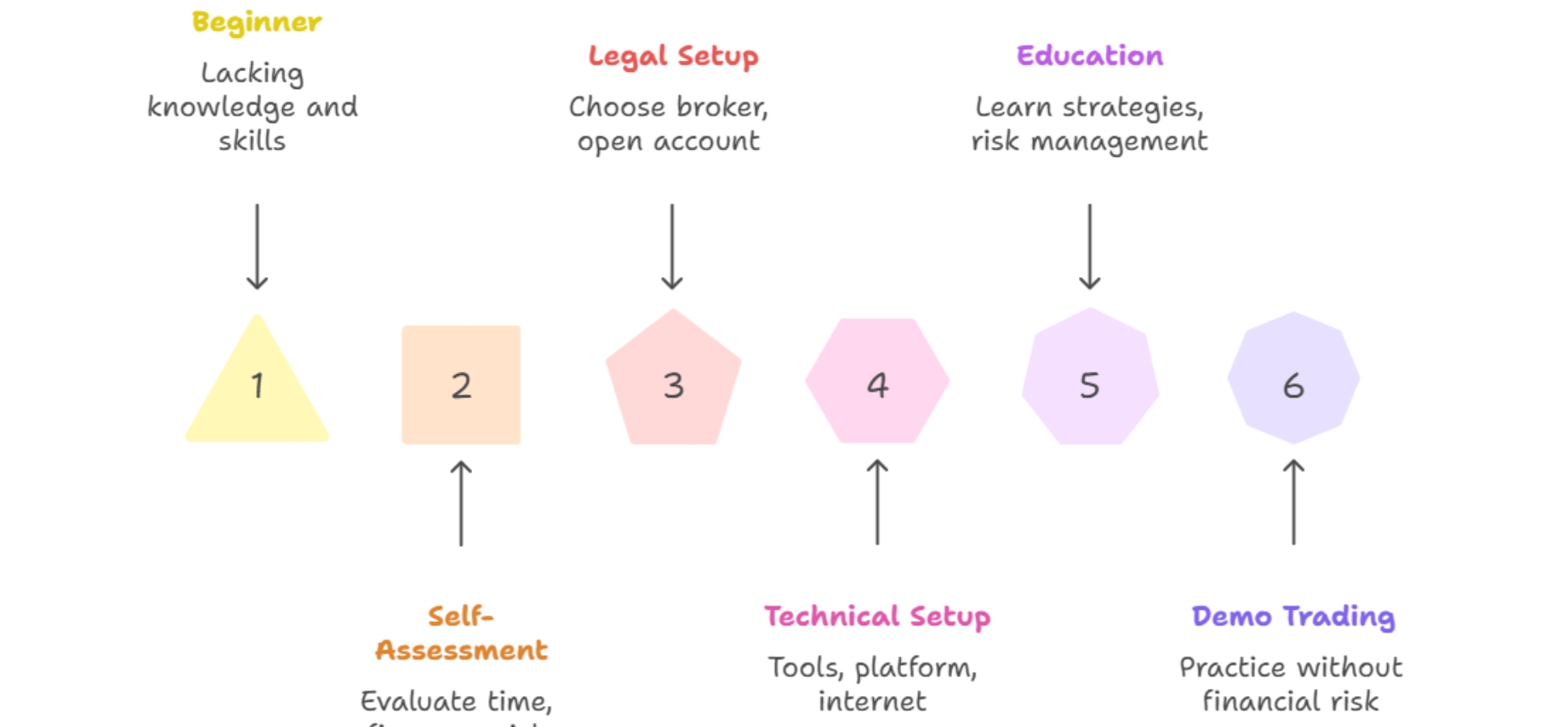
Before you jump into the action, you need a foundation. Successful day traders prepare long before placing their first order. Think of this as your pre-flight checklist — essential for safety and long-term success.
Self-Assessment: Time, Financial Cushion, and Risk Tolerance
Focus and time are needed for day trading. It would not be effective to try to trade while distracted or while trying to do another job. Think about whether you can truly set aside at least a few hours each day to monitor the markets.
You would also need a financial cushion. Emotional attachment to your trading capital almost always results in poor, impulsive decisions. Only trade with money you can afford to lose.
Lastly, evaluate your risk tolerance. If the answer is no, then it is best to start with demo trading. It will help to mitigate your risk. If minimal losses affect you negatively, then you should be prepared to start very slowly.
Legal and Technical Setup: Choosing a Reliable Broker
Next, find a trustworthy broker who offers efficient execution, competitive spreads, and solid regulation. For beginners, however, the most important thing is the broker’s reliability and support, not advanced trading tools.
After opening a trading account and completing the identity verification process, familiarize yourself with the broker’s trading platform. Check that it covers the markets you want to trade — stocks, forex, or crypto — and that it lets you set basic risk management, such as stop-loss orders.
Tools and Platforms You’ll Need
To trade effectively, you will need a real-time charting tool, live data feeds, and a solid internet connection. For all levels, MetaTrader, TradingView, or ThinkorSwim offers advanced charting and analysis tools.
Initially, keep your setup simple — one screen for charts, another for news, and one for trade execution. The aim is to avoid feeling overwhelmed.
Education and Mindset Preparation
Day trading isn’t a game of luck; it’s a learned skill. Invest time in education before risking a cent. Read reputable books, watch tutorials, and follow experienced traders who share practical insights.
Start with demo accounts to practice strategies without financial risk. You’ll learn how to execute trades, use stop-losses, and interpret chart patterns, all crucial before going live.
Most importantly, develop a calm and analytical mindset. You’re not trying to predict every move — you’re learning to manage risk and adapt.
Step-by-Step Guide to Start Day Trading

Once your foundation is ready, it’s time to take action. Here’s how to start your first day trading journey with clarity and discipline.
Pick Your Market
Not all markets behave the same way. Stocks, forex, crypto, and futures each have their own rhythm and volatility. For beginners, it’s best to focus on one market first.
Stocks are ideal for those who want liquidity and clear regulations. Forex offers 24-hour access and high leverage, while crypto markets run non-stop with massive swings. Choose based on your comfort level, risk appetite, and available trading hours.
Select Trading Strategies Suited for Beginners
Now that you have selected your market, you need to decide how to trade it. As a beginner, you will want to start with rule-based and straightforward strategies that do not involve intuition or guesswork. The focus here will be on consistent execution instead of a perfect trade.
Scalping, breakout, and momentum trading are some of the simplest strategies one can start with. Each of these helps you learn how price behaves in different market conditions. With momentum trading, you can take advantage of a strong price trend, whereas in breakout trading, you focus on times when the market breaks out of a range.
Whatever you settle on, do not be so quick to jump from one strategy to another. Understand the reasoning applied to your plan, what market behavior it applies to, and its highs and lows.
Risk Management Fundamentals
Before you place a single trade, you must master the art of protecting your capital. In day trading, risk management isn’t optional — it’s survival.
Every successful trader understands that losses are part of the game. What separates winners from losers is how they handle them. Start by defining how much of your account you’re willing to risk per trade. Most professionals recommend 1–2% of your total capital.
Always use stop-loss orders to exit losing positions automatically. This prevents emotional decision-making and limits damage when trades go wrong. Similarly, plan your risk-to-reward ratio — for instance, risking $1 to make $2 or $3. This ensures that even with some losses, you can still come out ahead over time.
Develop a Simple Trading Plan
Write a personal rule book. Describe when you trade, what you’ll trade, and how you will react when some conditions are met.
A solid plan includes
- Entry conditions: What will you look for before you open a trade?
- Exit conditions: When you realize a profit, when you realize a loss, and when you stop a trade?
- Position sizing: What portion of your money, your capital, will you spend for a trade?
- Review: How will you keep track of what you did, and how will you analyze it?
Ensure your plan is simple. The simpler the rules, the more you’ll be able to follow them.
Test and Iterate Before Going Live
Most beginners fail to test the plan. That can make or break your journey. Before you trade for real, make it your goal to spend time paper trading and revise the plan for use in real life. In back testing, you execute trades using your plan and see how markets would have reacted. You can simulate it to be risk-free for weeks or even more. You refine your rules to be more effective after weeks of learning how to analyze, which helps strengthen your trading plan.
Once your demo results show consistency, start small with real trades. Even a few dollars per position can teach valuable lessons about execution, emotions, and discipline. The goal isn’t to make big profits immediately — it’s to build habits that protect your capital and grow your confidence.
Popular Day Trading Strategies for Beginners

As you gain experience, you’ll discover that every trader has a preferred style. Some like fast-paced action, while others prefer waiting for the perfect setup. Below are several beginner-friendly strategies to explore — each with its strengths and challenges.
Momentum Trading
Momentum traders try to take advantage of strong trends by purchasing assets that are sharply moving upwards and selling the ones that are trending downwards. The essence of momentum trading hinges on the depth of activity in the market; the more people buy an asset, the stronger the price movement.
Momentum trading is best suited to highly active markets, particularly those influenced by strong news catalysts or economic indicators. For traders who are just starting, this strategy, which entails riding the market trend, is appealing in its simplicity, but one must always use stop-loss orders to protect capital in case the trend turns against the trader.
Scalping
Scalping involves executing multiple small trades during the trading day. These minimal profits are intended to accumulate to a larger, more meaningful one by the end of the trading session. Scalping is a very hands-on strategy that requires traders to monitor positions held for only a few seconds or minutes, capturing minimal price changes.
This trading style requires not only a well-thought-out strategy but also a specific state of mind, particularly focus, speed, and discipline. Sophisticated scalping strategies, contrary to popular belief, do not focus on predicting significant price movements but rather on the precision of one’s entry and the timing of the trade. The strategy can be very profitable but also tiring, which is why it’s essential to recommend starting small and gradually increasing the number of scalping trades.
Breakout Trading
Breakout traders look for price levels where an asset repeatedly fails to move higher or lower — known as support and resistance zones. When the price finally breaks out, they jump in, expecting a strong directional move.
For beginners, this strategy is appealing because it’s visual and easy to spot on charts. The key is confirmation: wait for a clear breakout with substantial volume before entering, and always use stop-losses in case the price reverses.
Pullback and Reversal Trades
Markets rarely move in a straight line. Even in strong trends, prices tend to “pull back” before continuing in the same direction. Pullback traders take advantage of these pauses — buying temporary dips in an uptrend or shorting rallies in a downtrend.
Reversal traders, on the other hand, try to catch trend changes early. While this can be profitable, it’s riskier because predicting reversals is difficult. Start by focusing on pullbacks — they’re more reliable for beginners.
Common Mistakes Beginners Make

Even the most prepared beginners fall into classic traps. Recognizing these mistakes early can save you from costly lessons later.
The most common error is overtrading — taking too many trades in a single session, often out of boredom or the desire to “make back” a loss. Overtrading not only increases costs but also drains your focus and discipline.
Another frequent issue is ignoring trading fees, spreads, and slippage. These small costs can silently eat into your profits, especially for high-frequency strategies like scalping. Always factor them into your calculations when setting targets.
Skipping stop-losses is another major pitfall. Hoping a losing trade will turn around is one of the fastest ways to blow an account. In day trading, protection always comes before profit.
Many beginners also chase “hot tips” from social media or trading groups. By the time a stock or crypto coin is trending online, the best entry has often passed. Successful traders rely on tested systems and discipline — not hype or luck.
Lastly, new traders often obsess over profits instead of the process. The best traders focus on execution, not outcome. If you follow your plan consistently, the profits will follow naturally over time.
Conclusion
Starting day trading as a beginner in 2025 can be daunting and scary, but it is not impossible.
All you have to do is prepare, plan, take action, and adjust as needed. Start by educating yourself and assessing your trading knowledge, then move on to practice trading with a simulated account. Create a simple trading plan, balance your portfolio in a way that you are in control of losses and wins, and analyze every trade carefully after the fact, regardless of whether it was winning or losing.
Lastly, you must realize that day trading is a skill set that is developed over time. It demands preservation, control of the mind, and endless improvement. The markets will always test you, but they will reward you if you finish the work.
Always start as far away from your goals as you can, maintain your mental stamina, and ensure you have control of your trades. You will have to work a lot to make sure that the trading you do when starting is profitable. Simply stated, many of the trades you will make will be losing trades. You will have many of those losing trades overall, but that is okay. With every beginner-level trade, you will be learning more, and the trades you make will be losing the most.