Fasting, which means not eating for a set time, isn’t a new diet trend. It’s an ancient practice used for cultural, spiritual, and healing reasons. The 36-hour fast is a serious challenge for your body. It’s more than just cutting calories; it puts your body into a special state. During a 36-hour fast, you avoid all calories for 36 hours straight. This is tougher than other popular methods like the 16:8 schedule or the 5:2 diet because it’s long enough to put your body into a true fasted state.
This guide goes beyond just weight loss. It will explain, organ by organ, what scientifically happens inside your body when you stop digesting food for this long. Think of this as a tour of your own biology. You’ll learn about the powerful survival and repair systems that turn on when your body gets a chance to rest and reset.
It’s important to know that a 36-hour fast is a big deal and isn’t for everyone. You need to understand what happens in your body and consider your own health before trying it. The goal here is to give you knowledge, not to tell you what to do. Always talk to a doctor before trying a long fast.
The First 12 Hours
The key to a 36-hour fast’s benefits is a major shift in how your body makes energy. This “metabolic switch” isn’t just about changing fuel. It’s the main trigger for your body’s survival and repair mode. If you understand this switch, you’ll see why a long fast is different from just skipping a meal.
Phase 1: The Anabolic & Catabolic Phases (Hours 0-16)
For the first 4 to 8 hours after you eat, your body is in the “fed” phase. It’s busy digesting food, taking in nutrients, and using sugar (glucose) from that meal for energy. Your insulin levels are high, which helps move this sugar into your cells to be used or stored.
Once your body processes the nutrients, it enters the next phase. Here, it starts breaking down stored energy to keep everything running. The first place it looks for energy is its glycogen stores, which is stored sugar in your liver and muscles.
Phase 2: Glycogen Depletion (Hours 12-24)
Your liver’s stored sugar (glycogen) is the main thing that keeps your blood sugar stable. But this supply is limited. Usually, these stores run low between 12 and 36 hours after you start fasting. When this happens depends on the person. Factors like your metabolism, how active you are during the fast, and what you ate in your last meal all play a role.
The “Metabolic Switch”
When your liver’s sugar stores run out, your body hits a key moment: the metabolic switch. At this point, your body has used up its easy-to-access sugar. It must now switch its main fuel from sugar to fat. This isn’t a small change. It’s a deep survival mechanism that has been part of human biology for a very long time. This switch starts a chain reaction of changes in your metabolism, cells, and hormones. This sets up the deeper effects of the fast. Without this switch, deeper processes like making ketones and cleaning out cells (autophagy) don’t really get going. Your body basically switches to a different operating mode.
An Organ-by-Organ Guide to the Fasted State (Hours 12-36)

After the metabolic switch happens, your major organs start a series of amazing and coordinated tasks. Each system adapts to the lack of food differently. They focus on saving energy, repairing cells, and using new types of fuel.
The Liver
During a 36-hour fast, your liver’s job changes completely. It stops storing sugar and becomes the command center for the body’s new fat-burning system. It manages energy production, detoxification, and cell maintenance.
- Ketogenesis: When the sugar stores are empty, fat cells release a lot of free fatty acids (FFAs) into your blood. The liver takes these FFAs and turns them into energy molecules called ketones, mainly beta-hydroxybutyrate (BHB) and acetoacetate. It then releases these ketones into the blood for other organs to use as fuel, especially the brain. This process speeds up the longer you fast. Within 24 hours, your blood ketone levels can jump from almost zero to 2 to 5 mM. A 36-hour fast can make the amount of BHB in your blood four times higher, which means you are in a strong state of ketosis.
- Cellular Cleanup (Autophagy): The long break from processing food lets the liver focus on itself. It starts a process called autophagy, which is like “housekeeping” for your cells. Liver cells find, break down, and recycle old or damaged parts. This cleanup helps reduce inflammation, clear out fat, and grow healthy new liver cells.
- Managing Byproducts (Urea Cycle): While your body is burning fat, it also breaks down some protein from muscles. This creates a toxic byproduct: excess nitrogen. The liver has a system to handle this. It uses the urea cycle to turn the excess nitrogen into urea, which the kidneys can then safely remove. This process not only prevents toxins from building up but also helps burn more fat, adding to the fast’s benefits.
The Brain
Your brain uses more energy than any other organ. During a fast, it adapts by switching to a new fuel. Some researchers believe the brain doesn’t just survive on this fuel, but actually does better with it.
- Switching to Ketones: When you’re eating normally, your brain runs almost entirely on sugar. But during a long fast, it switches to using ketones as its main fuel. Ketones are a very clean and efficient energy source for brain cells. This fuel switch is thought to protect the brain and may help “rescue the brain from cognitive deterioration related to aging”.
- Boosting Brain-Derived Neurotrophic Factor (BDNF): Fasting, like exercise, tells the brain to make more of a powerful protein called brain-derived neurotrophic factor (BDNF). BDNF is vital for the growth and survival of brain cells. It helps with learning, memory, and making new connections in the brain. Higher levels of BDNF also make brain cells stronger against stress.
- Neuronal Autophagy: The brain also benefits from cellular cleaning. New research shows that even short-term fasting can greatly increase autophagy in brain cells. This lets brain cells clear out damaged parts, like old mitochondria and bad proteins. This is important for long-term brain health and may protect against diseases where this kind of cellular junk builds up.
- Improved Cognitive Function: The combination of using efficient ketone fuel and having more BDNF might be why many people say they feel mentally sharp, alert, and focused during a fast. This could be an evolutionary trait; when food was scarce, the brain needed to be sharp to find more.
Fat Stores and Muscles
During a 36-hour fast, your body calls on its largest energy source—your fat stores—to provide fuel. At the same time, it uses a smart strategy to protect your muscle.
- Lipolysis: With low insulin levels, fat cells speed up the process of lipolysis. They break down stored fats into free fatty acids (FFAs) and glycerol and release them into the blood. A 36-hour fast causes a huge increase in these fuels. One study in trained men showed that a 36-hour fast raised resting levels of FFAs by 107% and glycerol by 200% compared to a normal overnight fast.
- Muscle Fuel Adaptation: Your muscle cells are very flexible and quickly switch to using these FFAs and ketones for energy. This is important because it saves the limited sugar and ketones for the brain, which needs them more. While some muscle protein is used for energy, the body’s main shift to burning fat helps protect muscle tissue from being broken down too much.
- Physical Performance: Although your body becomes better at burning fat, this state is for survival, not for top athletic performance. A 36-hour fast can greatly reduce your endurance for hard exercise. The same study that saw the jump in FFAs also found that the time it took to get exhausted during a cycling test was cut by 38% after a 36-hour fast. This shows why it’s important to reduce physical activity and avoid intense workouts while fasting.
The Digestive System
Your gut is always working. It digests food, absorbs nutrients, and watches for threats to your immune system. A 36-hour fast gives your gut a rare and valuable chance to rest, repair, and rebalance.
- Gut Rest and Repair: Even the natural fast during sleep lets the cells lining your gut repair themselves. A longer fast can boost this effect, helping to make the gut barrier stronger. A strong gut barrier is key for getting nutrients while keeping harmful bacteria and toxins out of your bloodstream, which can cause inflammation throughout the body.
- Microbiome Shifts: The trillions of microbes in your gut change depending on whether you’re eating or not. Fasting can cause big shifts in these microbes, often leading to more diversity of good bacteria. Studies show increases in healthy bacteria like Lachnospiraceae and Bacteroidetes, which are linked to better metabolism and less inflammation. However, these changes aren’t permanent. Research shows that once you start eating normally again, your gut microbes tend to go back to how they were. This means the gut benefits of fasting are like a periodic “reboot.” The real long-term benefit comes from fasting regularly and eating a healthy diet to support a diverse microbiome.
The Heart and Cardiovascular System
How fasting affects heart health is complicated. There are clear short-term benefits, but some long-term studies raise new questions. This shows an important point: fasting is a powerful stress on the body. Its final effect depends on a person’s overall health and lifestyle.
- Short-Term Benefits: A lot of research shows that intermittent fasting can improve key signs of heart health. These benefits include lower blood pressure, resting heart rate, LDL (“bad”) cholesterol, and triglycerides. These improvements are often tied to the weight loss and anti-inflammatory effects of fasting.
- Long-Term Questions: A recent large observational study raised questions about the long-term effects. The early findings showed a link between eating in a window of less than 8 hours a day and a much higher risk of death from cardiovascular disease over about eight years.
- Correlation vs. Causation: It’s important to be careful with these findings. Because it was an observational study, it only shows a statistical link; it doesn’t prove that the eating pattern caused the higher risk. Many other factors could be involved. For example, the people in the study who ate in a restricted window might have had a worse diet overall, lost more muscle (which is bad for the heart), or had eating patterns that didn’t match their body’s natural clock (like skipping breakfast and eating late). The conflicting information shows that your whole lifestyle matters, not just when you fast. More research is needed to be sure.
The Hormonal Response
The deep changes that happen during a 36-hour fast aren’t random. A complex system of hormonal signals controls them. These hormones tell your body when to save energy, when to release stored fuel, and when to start repairs. This hormonal response has two sides. It can be helpful in some ways but requires caution in others.
- Insulin and Glucagon: These two hormones from the pancreas are at the center of the metabolic switch. When you stop eating, insulin levels drop. Low insulin is the main signal that tells your body to stop storing fat and start burning it. At the same time, levels of glucagon, insulin’s opposite, start to rise. Glucagon tells the liver to release its stored sugar and then to start making ketones from fat.
- Human Growth Hormone (HGH): One of the biggest hormonal changes during a long fast is a huge spike in human growth hormone (HGH). Studies have reported increases of several hundred percent, with some people seeing a jump of over 1,200%. This HGH spike does two important things: it helps protect your muscle and bone, and it pushes your body to use fat for energy.
- Stress Hormones (Cortisol & Adrenaline): Fasting is a type of good stress on the body. Because of this, it raises levels of stress hormones like cortisol and adrenaline. In this case, the increase is a necessary part of the body’s adaptation. These hormones are key for getting energy, signaling the breakdown of stored sugar, and releasing fatty acids from fat stores.
- Thyroid Hormones: Your body is smart and tries to save energy when food is scarce. One way it does this is by temporarily slowing down the thyroid gland. Levels of active thyroid hormones (T3 and T4) tend to drop during a long fast. This causes a small, temporary drop in your metabolic rate—a way to save resources until you eat again.
- Reproductive Hormones: The body’s focus on survival during a fast can also affect reproductive hormones. Research suggests that intermittent fasting may lower levels of androgens, like testosterone, in both men and women. For women with conditions like Polycystic Ovary Syndrome (PCOS), where androgens are high, this could be a good thing. But for men, lower testosterone could negatively affect their metabolism, muscle, and libido. For women, big changes in calorie intake can also disrupt the menstrual cycle. This shows how the body shifts resources away from things that aren’t essential for immediate survival, like reproduction.
How To Break the Fast
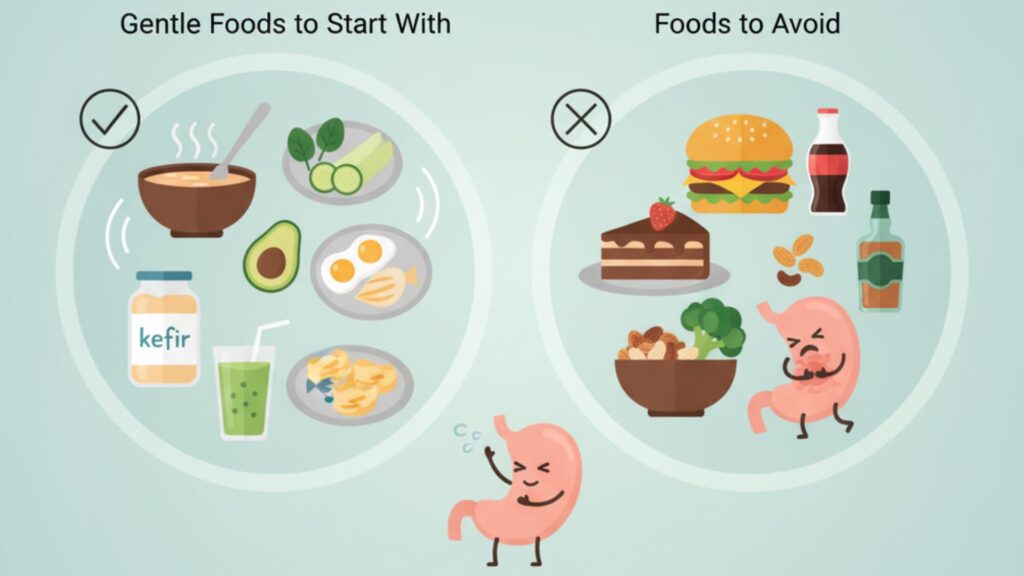
How you break a fast is just as important as the fast itself. After 36 hours of rest, your digestive system needs to be woken up gently. Eating a large, heavy, or sugary meal right after the fast can shock your system. This can lead to digestive problems like bloating, nausea, and diarrhea, and cause sharp spikes in your blood sugar. The key is to start with small, easy-to-digest foods that are packed with nutrients.
| Table 1: How to Safely Break Your 36-Hour Fast | |
| Gentle Foods to Start With (Your First Meal) | Foods to Avoid Initially (For the First Few Hours) |
| Bone Broth | Large, heavy meals |
| Steamed, non-starchy vegetables (e.g., zucchini, spinach) | Sugary drinks, desserts, and refined carbohydrates (white bread, pasta) |
| Avocado | Greasy or fried foods |
| Small portion of lean protein (e.g., eggs, fish) | Alcohol |
| Fermented foods (e.g., unsweetened yogurt, kefir) | Large amounts of raw vegetables or nuts (can be hard to digest) |
| Smoothies (low sugar, with protein and healthy fats) | Spicy foods |
Who Should NOT Attempt This Fast:
- Women who are pregnant, planning to become pregnant, or breastfeeding: Fasting during pregnancy can increase stress hormones, raise the risk of early labor, and harm the baby’s development. While breastfeeding, it can affect milk supply and quality.
- Children and teens under the age of 18: Their bodies are still growing and have different nutritional needs.
- Individuals with a history of or a current eating disorder: Fasting can trigger or worsen eating disorders.
- Individuals who are underweight: Fasting is not for those who don’t have enough energy reserves.
- People with diabetes (Type 1 or Type 2): Fasting carries serious risks of dangerously low or high blood sugar and diabetic ketoacidosis. Anyone with diabetes should only consider fasting under the close watch of a doctor who can adjust their medication.
- Anyone with a chronic medical condition: People with liver disease, kidney disease, thyroid problems, or other chronic health issues must talk to their doctor before trying a long fast, as it can stress these systems.
Why Consider It? A Summary of Potential Benefits
Based on the science, a periodic 36-hour fast may offer several key benefits by putting your body into a unique state. These include:
- Deep Cellular Cleanup: The fast is long enough to start significant autophagy, your body’s way of recycling old and damaged cell parts. This is key for keeping cells healthy and may help protect against diseases that come with age.
- Metabolic Flexibility: By forcing your body to use up its sugar stores and enter ketosis, the fast trains your body to become better at burning fat for fuel.
- Improved Insulin Sensitivity: Giving your body a long break from processing sugar can help improve insulin sensitivity. This is a key factor in controlling blood sugar and lowering the risk of metabolic syndrome.
- Potential Cognitive Boost: The brain’s use of ketones and the increase in BDNF may lead to better mental clarity during the fast and support long-term brain health.