
Clients keep asking you for SEO, yet Reddit horror stories about spam links and ghosted vendors give you pause. Hiring an in-house senior specialist costs €50,000–€70,000 a year—before tools—so the seat stays empty while the requests pile up.
White-label SEO closes that gap. You steer the strategy and own the client relationship, while a vetted partner does the production work and pipes results into a dashboard branded as your agency. The client sees your logo; you keep the margin.
This guide explains what white-label SEO is, why it lets small agencies grow revenue without adding headcount, and exactly how to fold it into your service menu—from the day-to-day workflow and reporting to pricing, partner selection, and the pitfalls that trip up first-timers.
What white-label SEO actually is
White-label SEO is outsourced optimisation that you resell under your own brand. A specialist partner runs the audits, on-page fixes, content, and link building; you package it, price it, and present it to the client as your agency’s work. Nothing in the deliverable, the dashboard, or the invoice reveals a third party was involved.
It helps to separate two roles that small agencies often blur together:
- Strategy and relationship—yours. You scope the engagement, set priorities, communicate progress, and own the account. This is where your local-market knowledge and client trust live.
- Production and fulfilment—theirs. The partner writes the blog posts, earns the links, fixes the technical issues, and generates the reports. This is the labour-heavy work that would otherwise force you to hire.
The white-label arrangement only works if that division is invisible to the client. That means a partner who delivers logo-free reports, hosts dashboards on your domain, and never emails your client directly without your say-so.
Why small agencies offer white-label SEO
For an agency with a handful of staff, white-label SEO is the fastest way to turn existing demand into recurring revenue without betting the payroll on a senior hire.
- Revenue without headcount. You can say yes to SEO requests today instead of turning them away or scrambling to recruit. A single retained client can cover the wholesale cost of fulfilment many times over.
- No fixed salary risk. A senior in-house SEO is a $50,000–$105,000-a-year commitment before tools, and the work rarely starts full the day they arrive. White-label cost scales with the clients you actually sign—pause a client, and your cost pauses with them.
- Capacity that flexes. Win three new clients in a month and the partner absorbs the load; lose one and you are not stuck paying a salaried specialist to sit idle.
- Broader menu, stickier accounts. Adding SEO alongside the web, social, or PPC work you already sell gives clients fewer reasons to look elsewhere—and gives you more to cross-sell.
The trade-off is margin. You will not keep 100% of the retainer the way you would with in-house delivery once that hire is fully booked. But for most small agencies the math favours white-label until SEO volume is steady enough to justify a dedicated salary—and even then, many keep a partner for overflow.
How to add white-label SEO to your service menu
You do not need to rebuild your agency to start. The cleanest path is to add SEO as a productised line on the menu you already sell.
- Pick a starting scope you can explain in one sentence. “Monthly local SEO: technical fixes, four posts, link building, and a ranking report” is sellable. A bespoke, infinitely customisable scope is not—at least not yet.
- Decide your tiers. Most agencies land on two or three: a starter local plan, a national or competitive plan, and an à-la-carte option for one-off needs like a content burst or a citation clean-up. Mirror whatever your partner already fulfils so your menu and their delivery line up.
- Build the proposal once. Draft a branded one-pager per tier—deliverables, timeline, and price—so quoting a new prospect takes minutes, not an afternoon.
- Set the client-facing promise carefully. Sell outcomes you can stand behind (“improved visibility and steady content output”), never guaranteed rankings. That single discipline keeps you out of most of the trouble agencies get into.
Once the menu exists, selling SEO becomes a checkbox on your existing sales calls rather than a new business line you have to launch.
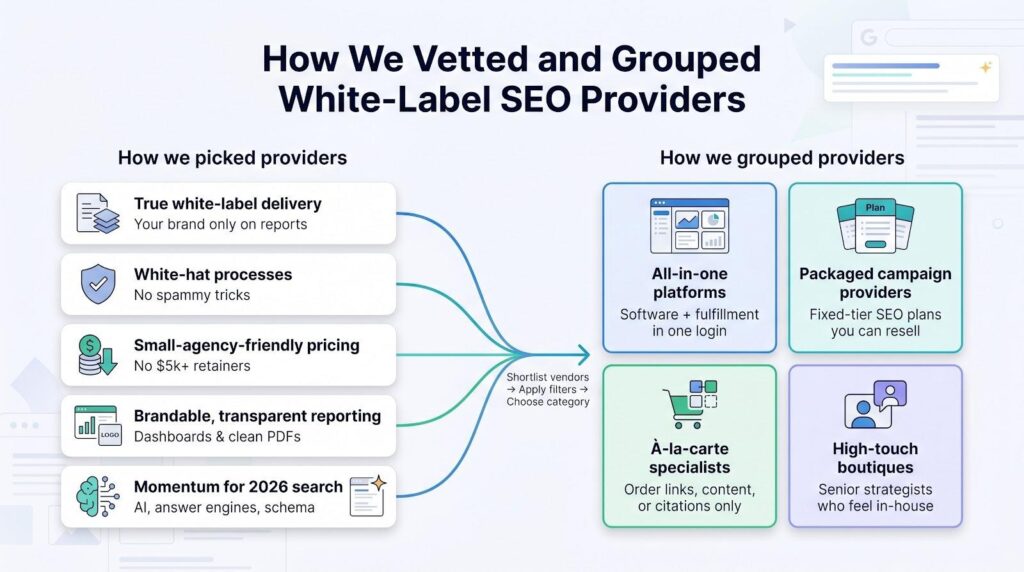
How the workflow and reporting actually run
The reason white-label SEO feels like having an in-house team is that the day-to-day operates on a predictable loop. Understanding that loop before you sell makes onboarding painless.
A typical engagement runs like this:
- Onboarding and audit. You hand off the client’s site, goals, and target keywords. The partner runs a technical and content audit and returns a roadmap—usually within the first week or two.
- Quick wins first. Technical fixes and Google Business Profile tweaks tend to land in the first 30 days. These give you screenshots and early talking points for the first client check-in.
- The monthly cadence. After that, most partners settle into a content → links → reporting rhythm: a few posts, a batch of links, and a refreshed report each month.
- Reporting under your brand. This is the part that has to be right. The partner’s dashboard or PDF should carry your logo, sit on your domain where possible, and never expose another company’s name. Some partners will even send report emails from an address on your domain.
Your job inside this loop is light but important: relay client context to the partner, review deliverables before they reach the client, and present results. Everything heavy happens behind the curtain.
The faster you can produce a clean, logo-free report, the more professional you look. A two-minute branded audit PDF turns a cold prospect call into a warm one, and a real-time portal answers the “what did we get last quarter?” question before the client even asks.
How to price it and protect your margins
Pricing is where white-label SEO either becomes a profit centre or a slow leak. The model is simple: you pay a wholesale cost, you charge a retail price, and the gap is yours. Keeping that gap healthy takes a little discipline.
- Know your true wholesale number. Entry-level local SEO campaigns commonly start around $300–$500 wholesale; national or e-commerce scopes run higher. Confirm whether there is a separate platform or software fee on top, because that quietly eats into margin.
- Mark up with room to support. A common rule of thumb is to roughly double wholesale—resell a $499 plan near $999, a $300 plan near $750. That spread covers your account-management time, not just the partner’s invoice.
- Watch the à-la-carte math. One-off items price differently: guest posts often run $80–$150, a 500-word article $25–$40. These are great for tight budgets and specific asks, but they carry less recurring margin than a retainer, so use them to win or upsell, not as your core offer.
- Protect margin when clients pause. Favour month-to-month wholesale terms so that when a client cancels, your cost stops too. Avoid partners whose fixed platform fees spike your costs the moment a client pauses.
- Price the relationship, not just the deliverables. Hands-on clients who want weekly calls and live strategy sessions cost you more time—charge accordingly. Boutique-style fulfilment that includes that hand-holding runs higher wholesale (often $600–$1,000+ a month), so your retail price has to reflect it.
Run the numbers before you quote, not after. “If I bring ten $500 local campaigns, what is my wholesale and turnaround?” is a question you should be able to answer in your sleep.
How to choose a white-label partner
Picking a partner is risk management, not guesswork. The wrong one shows up as missed deadlines, spammy links, and an awkward call where you have no answers for your client. Run every contender through these five gates before you sign anything.
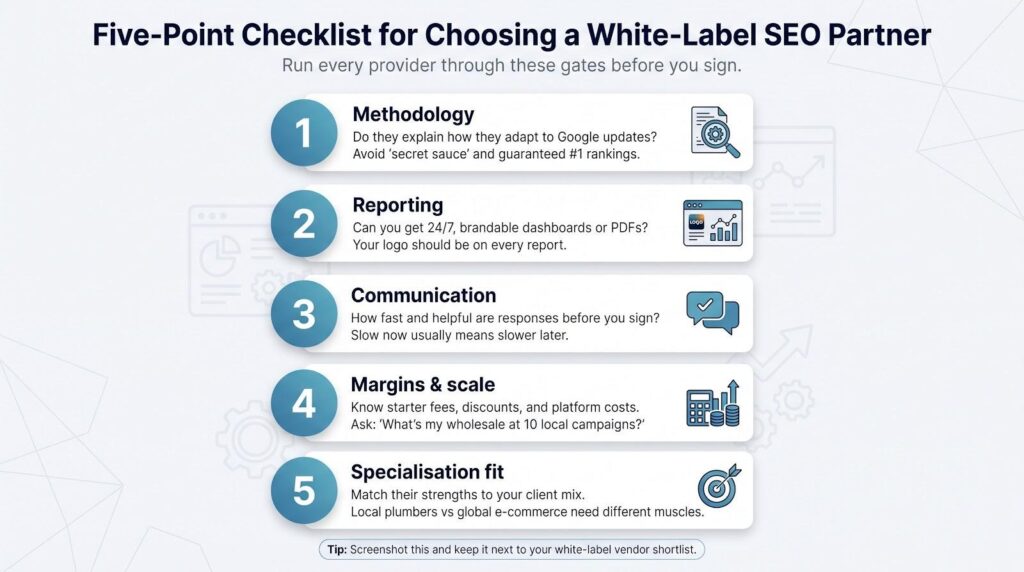
- Methodology. Ask how the team stays ahead of Google updates. A credible partner will outline specific, white-hat process tweaks—not “secret sauce.” Run from anyone who guarantees a number-one ranking; they are either using risky tactics or selling hype.
- Reporting. Insist on brandable, round-the-clock access. Your logo should sit on every dashboard and PDF. The best partners now track both classic rankings and AI-search visibility—whether your client appears in answer engines and Google’s AI overviews—all under your domain.
- Communication. Scan reviews and agency forums; missed deadlines and canned replies are the most common complaints. Test response time and depth of answers during the sales conversation. Slow now usually means slower later.
- Margins and scale. Confirm starter fees, volume discounts, and any platform costs, then check that fulfilment can absorb your growth. A partner who handles five clients but buckles at fifty will cap your agency.
- Specialisation fit. Match their strengths to your roster. Local service businesses need citation and review muscle; competitive e-commerce demands technical depth and multilingual outreach. The right partner is the one built for your client mix, not necessarily the cheapest.
A strong all-in-one option that checks these boxes is White Label SEO from Agency Platform: a portal you host on your own domain, with fulfilment that already supports more than 1,200 agencies handling audits, on-page work, content, links, and even PPC. Its Answer Engine reporting shows whether a client surfaces in generative search results, and membership starts around $178 a month and scales as you add campaigns at your own markup—useful for a small agency that wants a polished client portal without standing up its own tech stack. As with any partner, run it through the five gates above against your specific client mix before you commit.
Check all five boxes and you walk into every pitch knowing delivery risk is covered, free to grow the agency instead of apologising for it.
Common pitfalls to avoid
Most white-label trouble is predictable—and avoidable.
- Promising rankings. “We’ll get you to #1” is the fastest way to a refund request. Sell visibility and consistent output, and let results speak.
- Letting the curtain slip. A report with someone else’s logo, an email from an outside domain, or a partner who contacts your client directly can unravel the whole arrangement. Control the logins and the communication chain.
- Skipping deliverable review. Forwarding the partner’s work to the client unread eventually delivers a thin post or an off-brief link with your name on it. Review before it ships.
- Under-pricing to win the deal. A retainer with no margin for your own time is a job you pay to keep. Price for support, not just wholesale.
- Going all-in on one untested partner. Start with a small engagement, watch a full content-and-link cycle, then scale. A trial month costs far less than migrating a dozen unhappy clients later.
- Choosing on price alone. The cheapest partner is rarely the one that survives a Google update or picks up the phone when a client is upset. Fit and reliability beat the lowest invoice.
Quick-answer FAQ
What is white-label SEO for small agencies?
White-label SEO is outsourced optimisation delivered under your brand. The provider writes content, builds links, and ships reports with your logo, so clients never know a third party exists.
Should I hire in-house or use a partner?
Unless you consistently need 30 to 40 hours of SEO work each week, a white-label partner is cheaper. U.S. senior-SEO salaries now average about $105,000 a year before tools, while many starter plans run $500 to $800 per month and scale only when you sell more work.
Can anyone guarantee a number-one Google ranking?
No. Google itself states that no one can guarantee a number-one ranking. Run from vendors who promise it; they are either using risky tactics or selling hype.
How much does a basic campaign cost?
Plan on $300 to $600 wholesale for local SEO and $800 or more for national or e-commerce scopes. One-off tasks such as a DA-40 guest post can be under $100.
What if the provider folds?
Choose month-to-month terms and platforms that give you real-time, exportable reports. You will keep every deliverable—content, links, audits—and can move to another partner without legal snarls.
Will my client ever find out?
Only if you slip. Pick partners with fully brandable dashboards and report emails (some even use an address on your domain). Control the logins and communication chain, and clients see only your agency’s name.
Conclusion
White-label SEO lets a small agency say yes to SEO demand it could never staff on its own—turning requests it used to decline into recurring, branded revenue. Get the four fundamentals right—a clear service menu, a predictable workflow, healthy margins, and a partner that survives the five-gate test—and you can scale profitable SEO without adding a single salary. Keep this guide handy; it answers the questions that surface in nearly every sales call.